


August Overview
The July Fed minutes revealed an emerging, though not yet dominant, hawkish tilt. Three voting members ultimately supported a 25-basis-point increase in the federal funds rate. Although “most participants supported maintaining the current target range,” the minutes also noted that “several participants favored an increase,” indicating broader support for tightening than the three recorded votes alone suggested. With the economy and labor market characterized as solid and stable, respectively, participants focused on inflation, which remained above target and carried upside risk. Participants will continue evaluating incoming data, including whether uncertainty related to conflict in the Middle East and tariff effects clears in the coming months. A few of those “who favored raising the target range” viewed an increase as a possible first step toward more pronounced action if inflation pressures persisted. Data released since the meeting have generally been softer, perhaps giving officials who preferred to wait more room to do so. Even so, “many” participants believed that “tightening would likely be necessary if inflation did not decline.”
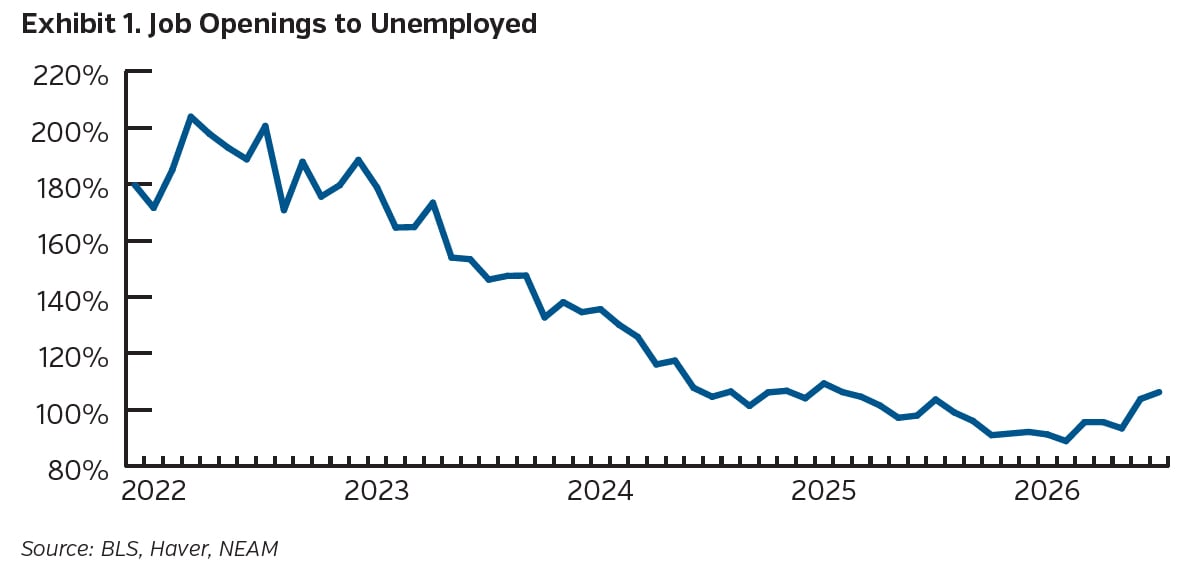
Although the committee characterized the labor market as stable, the month’s subsequent data were mixed. Nonfarm payrolls fell -23K, well below market expectations. The weakness largely reflected a decline in government employment; combined with downward revisions to prior months, it lowered the three-month average to +20K. Private-sector payrolls still increased, led by construction and private education, but losses in leisure and hospitality, financial activities, and retail trade offset part of those gains. Despite weaker payrolls, the household survey showed the unemployment rate edging down to 4.1%. The labor force contracted faster than employment, pushing the labor force participation rate down to 61.4%. JOLTS data offered similarly mixed signals: job openings increased, while hiring, quits, and layoffs rates declined. The ratio of job openings to unemployed workers also rose slightly, though it remained only modestly above 1X. Wage momentum softened, with average hourly earnings growth slowing to 3.2% from a year earlier and real earnings declining -0.2% over the same period. Consumer confidence also weakened during the month as inflation concerns increased.
The NFIB Small Business Optimism Index improved again, led by stronger hiring and capital expenditure plans.
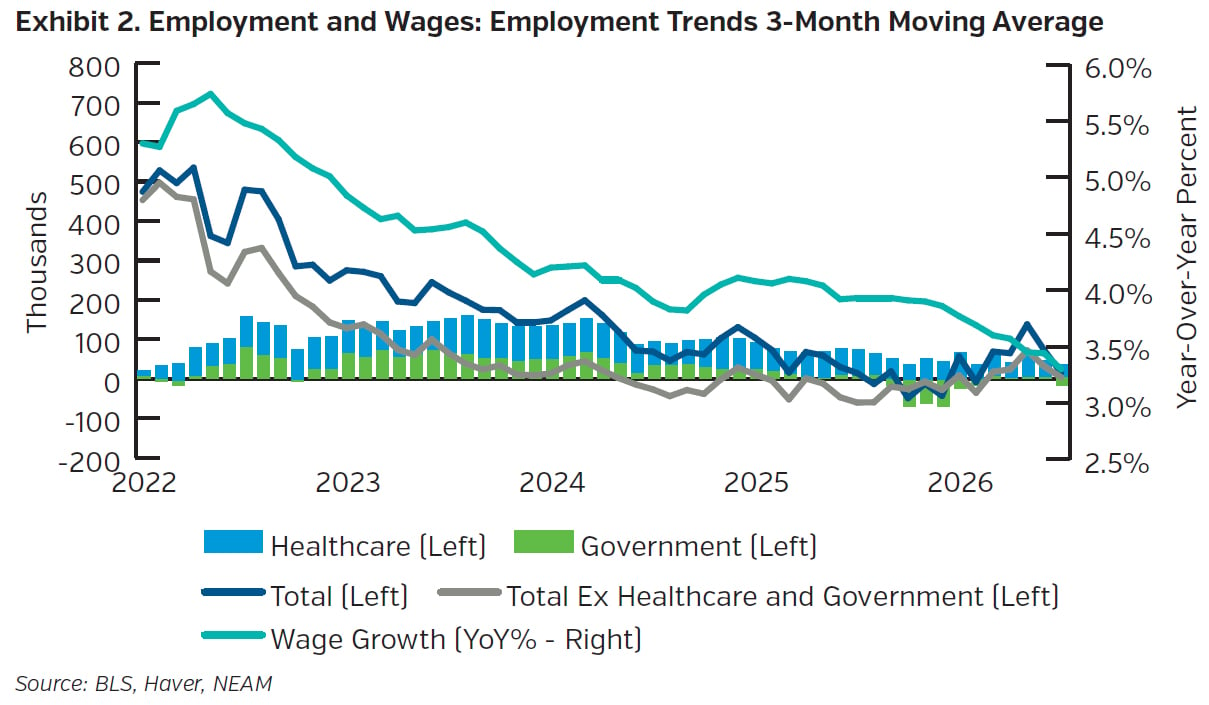
Small businesses continued to report difficulty filling open positions, with labor quality remaining their top employment concern across the sector even as worries about inflation eased. Manufacturing activity also remained firm: the ISM PMI registered 54.6, down slightly from the prior month but near its highest level since the first half of 2022. The reading stayed above 50 for an eighth consecutive month. Industrial production rose +0.2% for the month and 1.1% for the year. Mining and utilities increased +0.2% and 0.5%, respectively, while manufacturing gained +0.2%, or +0.4% excluding a decline in motor vehicle production. By market group, business investment remained a source of strength, rising +0.8% for the month and +6.6% for the year. Gains in information processing and industrial equipment led the advance, partly offset by lower transit equipment production.
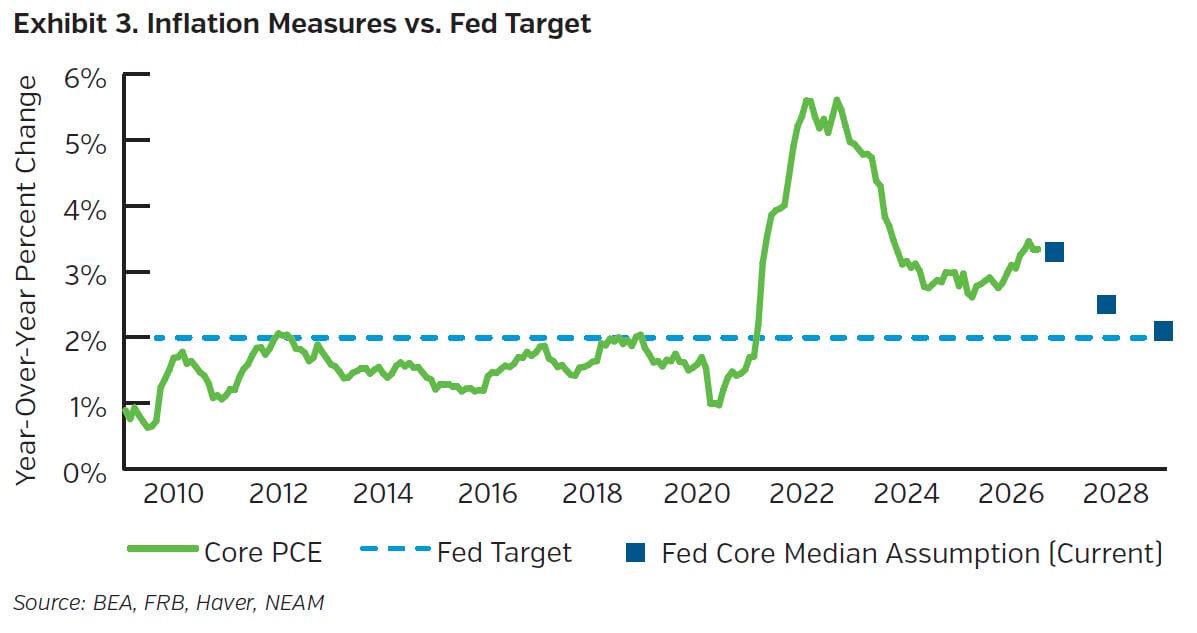
Headline CPI rose +0.1% for the month and 3.4% from a year earlier, while core CPI increased +0.2% and 2.5% over the same periods, respectively. Within core inflation, goods prices rose +0.2%, reversing the prior month’s -0.1% decline. Education and communication commodities, recreation goods and used vehicles led the increase, while lower medicinal drug prices provided a partial offset. Within core services, shelter inflation held at +0.1% overall: owners’ equivalent rent of primary residences increased, while lodging away from home weighed on the measure. Higher airline fares, medical care services, and education and communication services added further pressure, while lower motor vehicle insurance costs tempered the gain. Headline and core PCE each increased +0.2% for the month, translating to year-over-year gains of 3.7% and 3.3%, respectively. At Jackson Hole, Fed Chairman Warsh emphasized that the 2% target is a “firm, fixed target” and that it is the “Fed’s job to deliver stable prices.” Given those remarks and the breadth of current price pressures, the overall level and composition of inflation will remain central to the Fed’s policy discussions in the meetings ahead. Accordingly, inflation’s path will continue to shape the pace and timing of future policy decisions.
Capital Market Implications
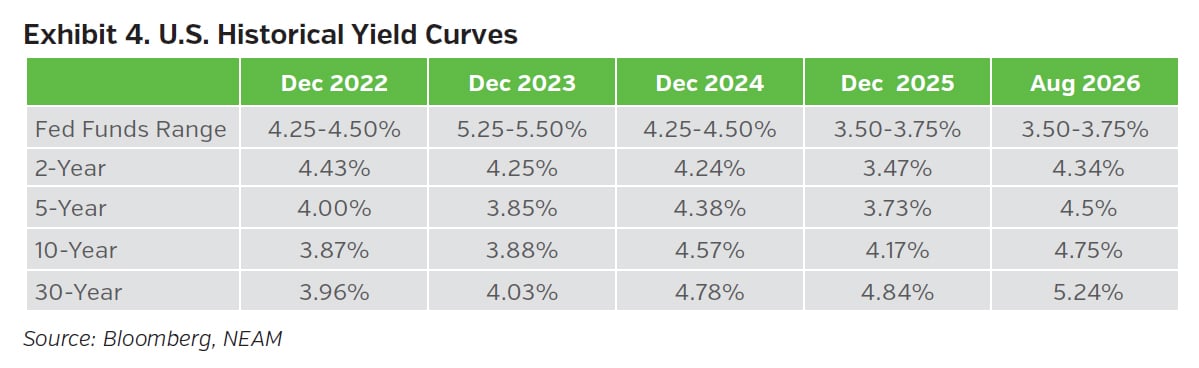
Heightened geopolitical risk and above-target inflation, together with resilient growth, a stable labor market and a hawkish-leaning Fed, kept Treasury yields elevated, while solid earnings supported equity market gains.
Capital Markets
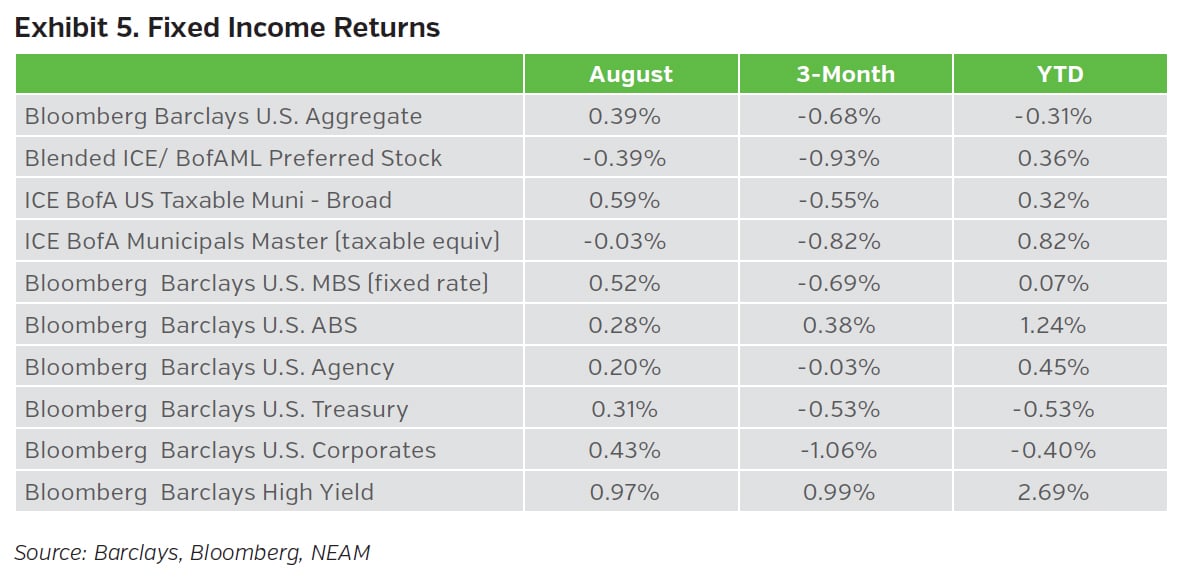
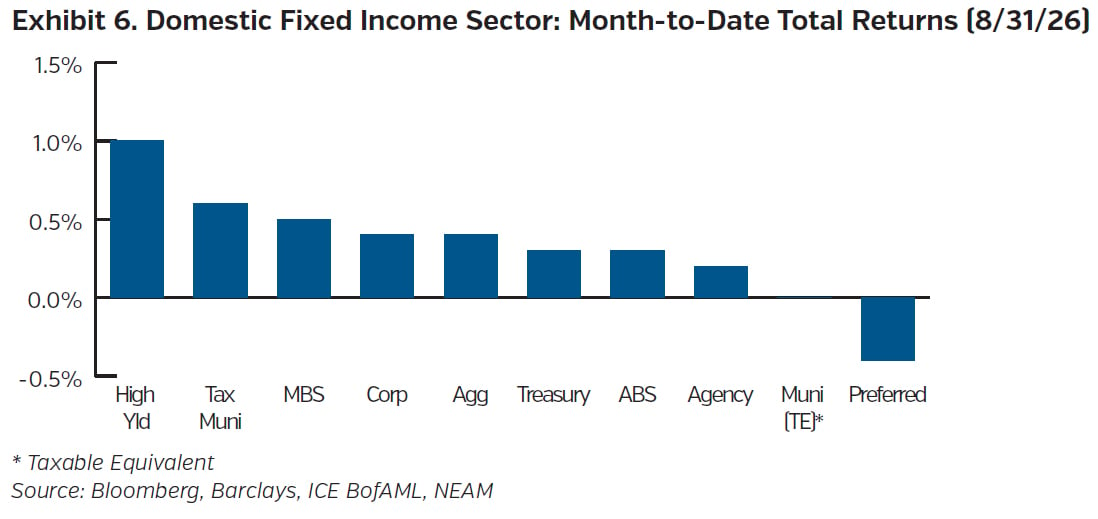
Fixed Income Returns
Hawkish leaning Fed rhetoric, ongoing geopolitical tensions, above target inflation and resilient growth kept Treasury yields elevated, while credit spreads remained relatively level.
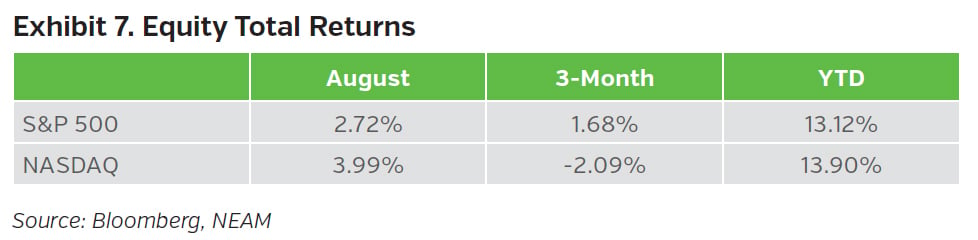
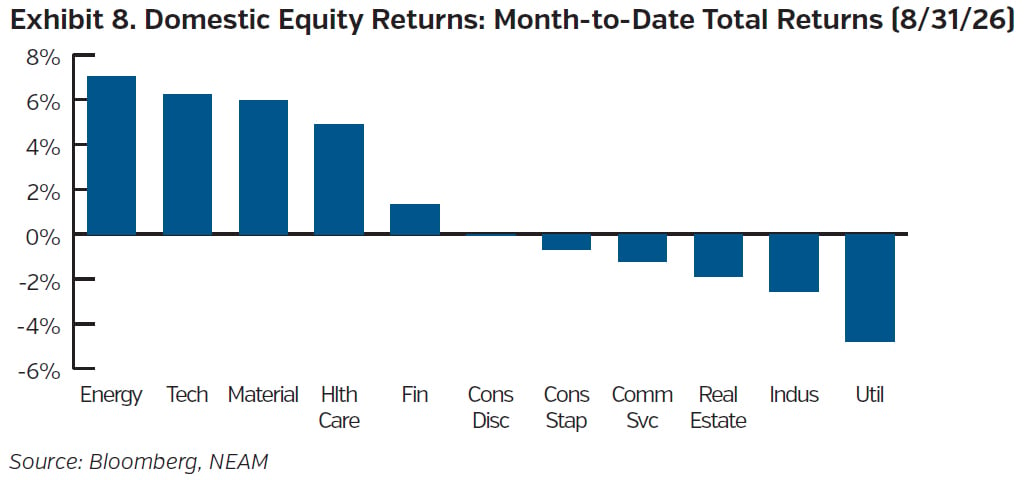
Equity Total Returns
Equity performance was positive in August, as stronger than expected earnings, particularly in the technology sector, outweighed a more hawkish tone from the Fed, continuing geopolitical tension and higher Treasury yields. The S&P 500, Nasdaq and Dow all ended the month higher.