


April Overview
Minutes from the Fed’s March meeting provided insight into potential outcomes at the April meeting. At the time of the March meeting, the committee felt that risks to both the inflation and employment sides of its mandate were “elevated,” with conflict in the Middle East magnifying these challenges. The “vast majority” of the committee at that point felt that rates should decline over time if inflation continued its downward trajectory, and an emerging chorus of voices wanted a more “two-sided” description of future rate moves. These discussions remained “vigorous” around guidance for the April meeting. Although the Fed held its benchmark rate unchanged at 3.5-3.75%, the accompanying statement highlighted growing divergence among committee members: three participants dissented against language suggesting an easing bias, while one member advocated for a move lower.
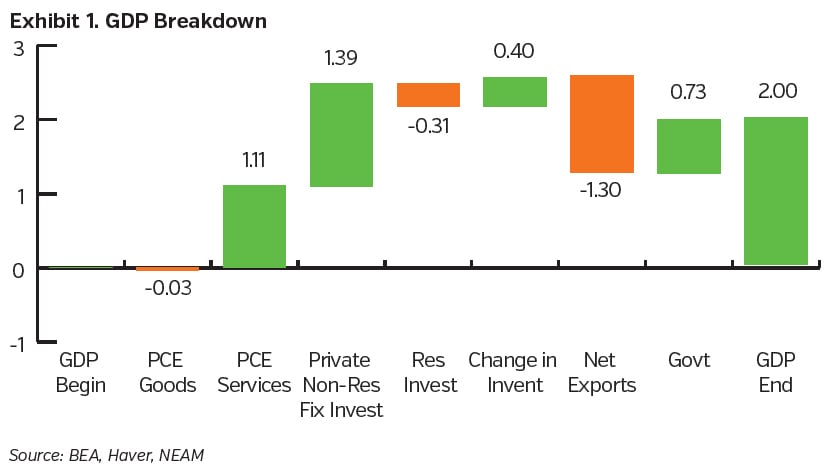
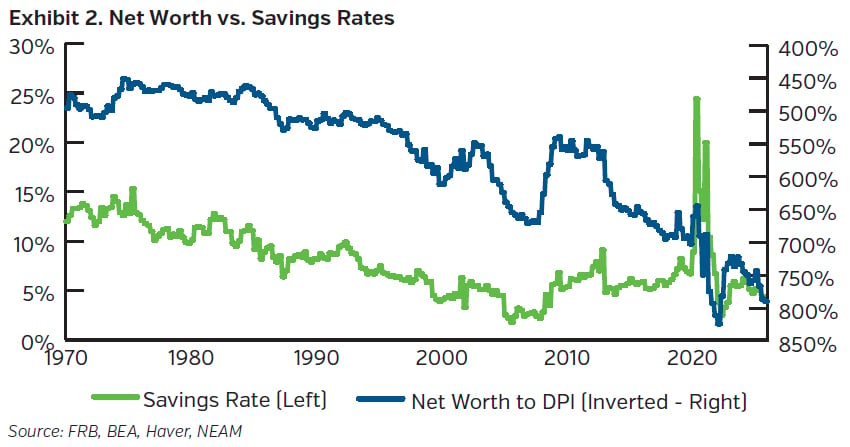
The University of Michigan’s Consumer Sentiment Survey suggests that the war in Iran is weighing on consumer confidence. The index fell for a second consecutive month to an all-time low of 49.8, as respondents broadly expressed concern about higher prices, weaker personal finances, and deteriorating buying conditions. In contrast, while still low historically, the Conference Board’s measure of confidence ticked up slightly, as improvements in consumers’ perceptions of the labor market and income prospects outweighed concerns about business prospects. The labor market differential increased marginally, as the “jobs hard to get” metric fell slightly. Although confidence remains subdued overall, the Fed minutes described household consumption as expanding at a more moderate pace, “supported by gains in household wealth.” Indeed, household net worth relative to disposable income has risen recently, while real consumption growth edged higher. Q1 2026 GDP showed consumption growing 1.6% annualized, led entirely by services as goods consumption lagged. However, with inflation rising, real incomes have come under pressure: real disposable personal income fell in the latest monthly figures, and consumers’ buffers are thinning as savings rates recede.
In the investment arena, the Fed minutes noted that business investment “remained robust, largely reflecting strength in the technology sector.” Indeed, Q1 2026 GDP showed business investment increasing 10.4% on an annualized basis, with AI-connected sectors contributing most of the increase.
Core durable goods orders and shipments exceeded expectations, rising 3.3% and 1.2% over the month, respectively, with sizable contributions from the computer and electronic products segments. In contrast, industrial production fell -0.5% in March. Reductions in the utilities (-2.3%) and mining (-1.2%) sectors contributed most to the decline, along with a smaller drop in manufacturing (-0.1%). The Fed’s Beige Book highlighted that manufacturing activity rose modestly in most districts. However, companies across the sector are grappling with higher energy and other input costs, as well as uncertainty related to ongoing tariffs and geopolitical developments. These themes were echoed by regional manufacturing surveys, which showed improved activity tempered by higher prices paid and a more cautious outlook going forward.
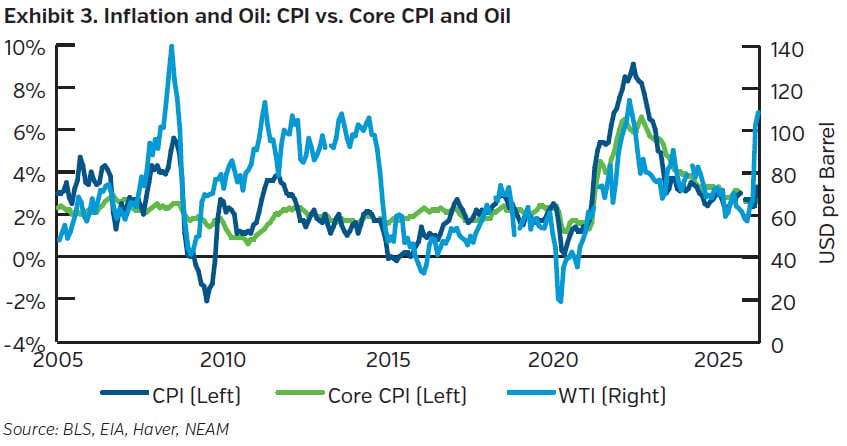
A +10.9% monthly rise in energy prices dominated the March CPI report and, when combined with flat food prices, helped push headline inflation to +0.9% for the month and +3.3% year-on-year. At the core level, prices increased +0.2%, in line with the previous month’s pace, bringing the yearly advance to 2.6%. Looking more closely, core goods maintained a +0.1% monthly pace (+1.2% year-on-year), led by gains in apparel, recreational commodities, other goods, and new vehicle prices, while household furnishings, used vehicle, and medicinal drug prices weighed on the index. On the core services side, shelter prices increased +0.3%. Transportation also contributed, supported by higher airline fares, while declines in recreation services and health insurance tempered the sector overall. Taken together, the inflation picture remains challenging for the Fed, as inflation is still above target and has been further clouded by the recent spike in headline inflation. The Fed continues to opt for patience, preferring to see how the data develops with respect to tariff and oil price effects, while longer-term expectations remain anchored despite shorter-term increases.
Capital Market Implications
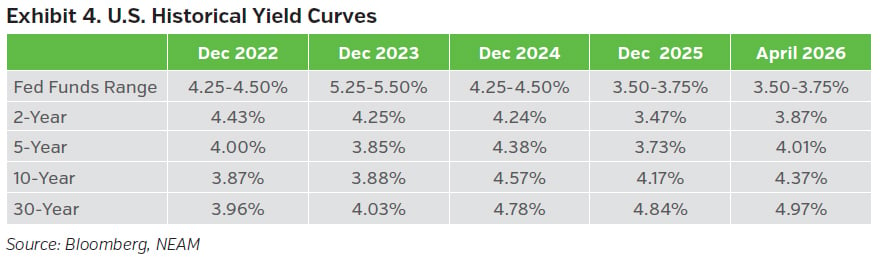
With heightened geopolitical tensions and above-target inflation persisting, the Fed held its benchmark rate steady as it continues to advocate for a balanced approach to its mandate. Treasury yields ended higher out the curve, while equity markets gained on improved earnings.
Capital Markets
Fixed Income Returns
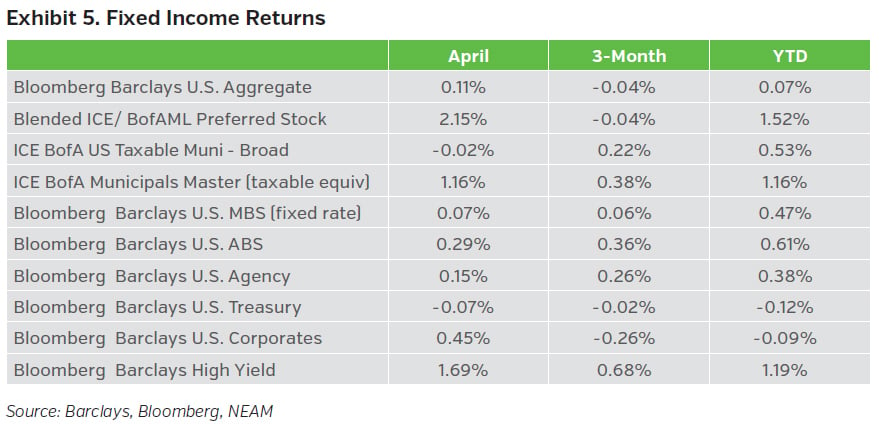
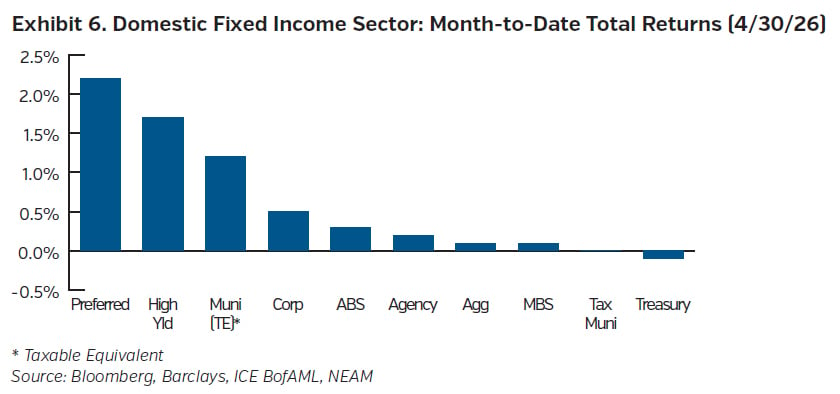
The Fed left its benchmark rate unchanged and maintained an easing bias in the statement. With inflation still elevated and the labor market seemingly stable, three voters dissented in favor of a more neutral stance in the statement. Fed governor Miran, conversely, dissented in favor of a 0.25% rate cut. Treasury yields rose over the month while credit spreads tightened as corporate earnings remained resilient in the face of geopolitical uncertainty.
Equity Total Returns
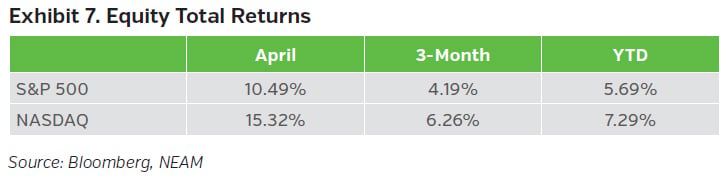
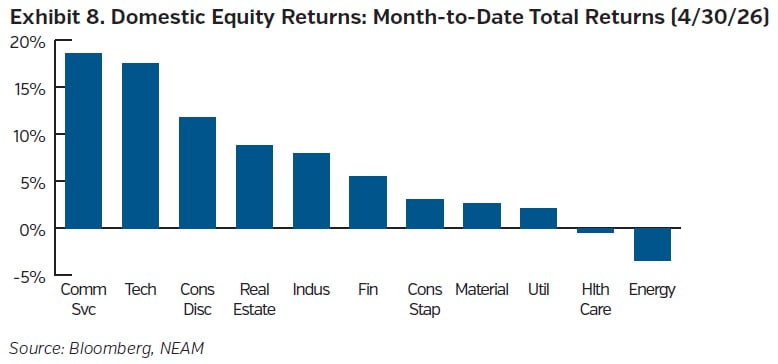
After a mixed first quarter of 2026 in which large cap U.S. equities lagged, equity markets posted impressive returns in April. Corporate earnings reports were generally strong. In addition, investors appeared to view any negative impacts from the Iranian conflict as likely to be both manageable and temporary. The S&P 500, Dow, and Nasdaq all ended the month higher.