


February Overview
With stabilizing employment data and “somewhat elevated” inflation, the Fed held rates steady at its last meeting. The minutes from the meeting highlighted a range of views amongst participants. The “vast majority” of Fed officials thought that downside risks to employment had moderated and wanted to see more progress on the inflation front before considering further rate cuts. Two Fed governors dissented from the decision and supported another rate cut. However, “several” not only backed the decision to leave the Fed funds rate unchanged but would have preferred a more balanced statement that alluded to the possibility of future rate hikes as well as cuts. With the risks to the dual mandate seemingly moving back into balance, incoming data appears set to drive future Fed decisions. A change in Fed chair, subject to Senate confirmation, injects some added uncertainty into potential Fed decisions, though.
In terms of employment, despite the annual benchmark revisions reducing the average monthly level of 2025 job additions from +49K per month to +15K, the January 2026 job numbers themselves came in above market expectations. Nonfarm payrolls increased by +130K for the month and were again led by gains in the healthcare area, with construction and professional business services also contributing to the job gains. The three-month average change in nonfarm payrolls increased to +73K from -22K the previous month. The household survey showed employment growth outpacing labor force growth over the month, with the unemployment rate falling to 4.3%. Within the JOLTS report data, the quits rate and layoff rate remained stable, pointing to a possible continuation of the low hiring and low firing levels of 2025, though the drop in job openings is of some concern.
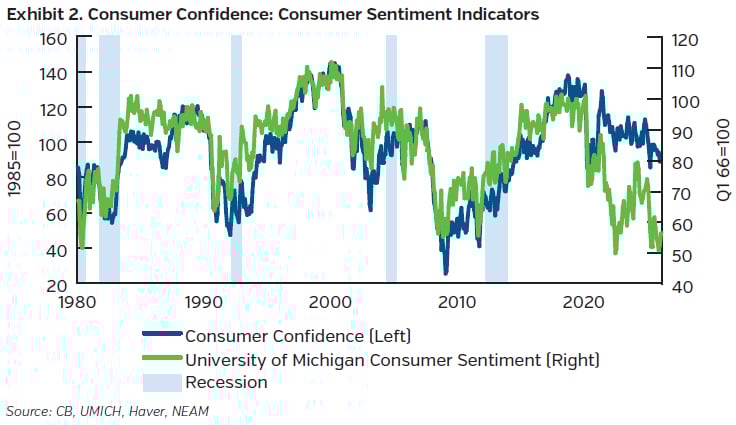
Although marginally better on the month, consumer sentiment surveys highlighted some ongoing worries, with both The University of Michigan’s consumer sentiment index and the Conference Board’s consumer confidence measure both still below historic averages. Meanwhile, the NFIB Optimism index showed that business optimism remained relatively level over the month. Manufacturing surveys improved at the national level despite showing some variation at the regional level. The ISM Manufacturing Index jumped to the highest level since 2022.
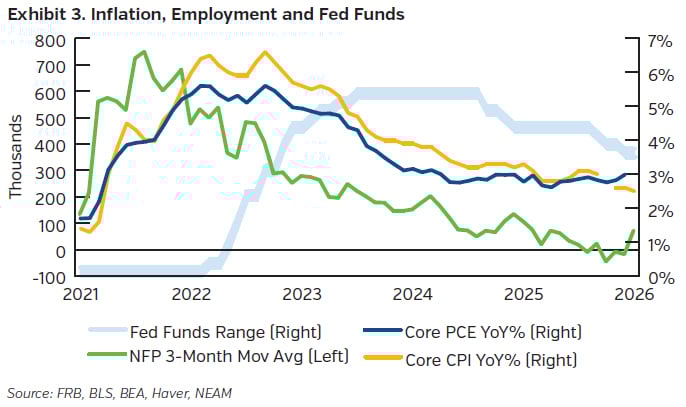
January’s CPI report came in lower at the headline level (+0.2% for the month), led by a notable drop in energy prices and more tempered food price gains, despite an uptick at the core level, which increased to +0.3% for the month. Core goods prices remained flat, with a decrease in used vehicles prices offsetting gains in areas such as recreation and personal care products. On the core services side, the pace of prices gains increased to +0.4% for the month. A spike in airline fares, amongst other transportation service price increases, helped drive core services inflation higher despite the pace of shelter price increases slowing to +0.2% in January. On an annual basis, the headline CPI inflation rate stood at +2.4%, while core CPI inflation came in at +2.5%. The core PCE inflation rate came in at +0.4% for the month and +3.0% for the year, perhaps strengthening the argument of those on the Fed who are more concerned about inflation.
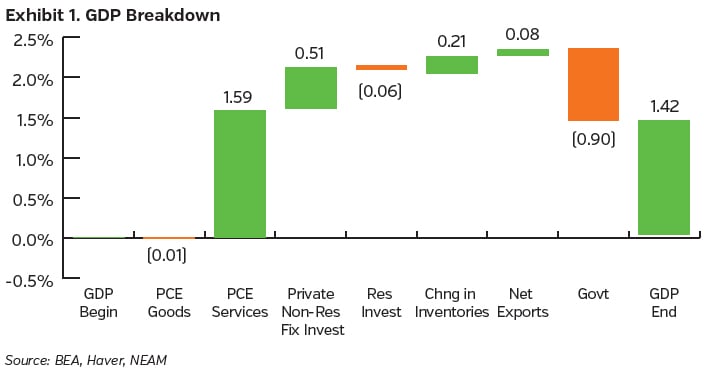
Within the Q4 GDP report, personal consumption expenditures rose at a +2.4% annualized rate, with services carrying the weight as goods consumption fell slightly. Business investment grew at a +3.7% annualized rate, led largely by spending on equipment and intellectual property products. The government shutdown contributed to a sharp drop in federal government expenditures, pulling overall real GDP growth down to a +1.4% annualized rate. However, final sales to private domestic purchasers increased at a more robust +2.4% annualized rate.
Capital Market Implications
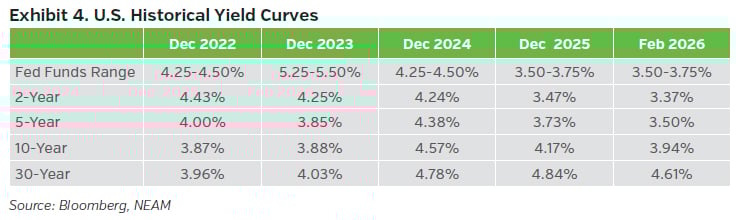
With employment data showing signs of stabilization and inflation still above target, Fed rate cuts do not appear likely in the very near term. However, while money market yields were little changed in February, intermediate to longer maturity Treasury yields fell. Equity market performance was mixed. Most fourth quarter earnings reports appeared solid, but many investors seemed to grow increasingly concerned about potential disruption, driven by AI advances, for software companies and other businesses.
Capital Markets
Fixed Income Returns
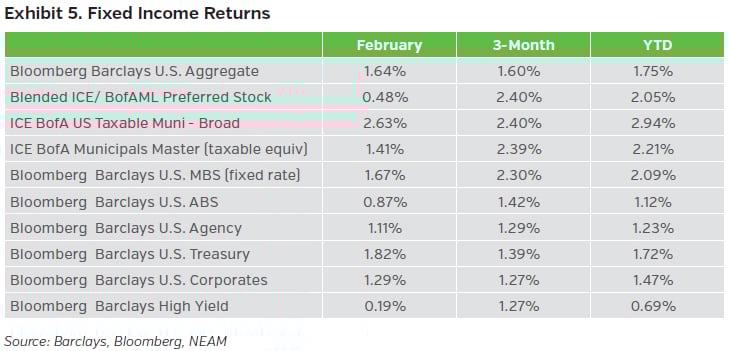
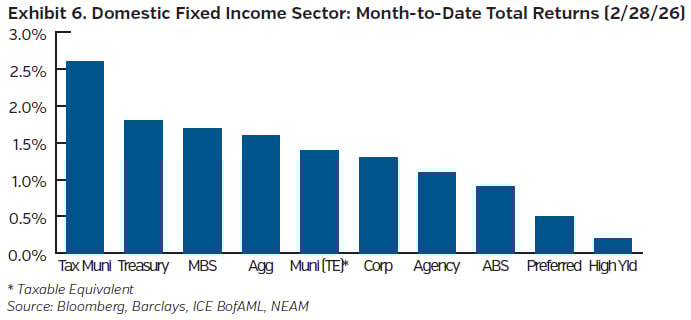
Fed minutes shared its intent to hold rates steady in the near term, while heightened geopolitical risk, trade policy uncertainty and a more cautious tone towards credit risk left Treasury yields lower for the most part while credit spreads moved wider as AI disruption, private credit and heavy supply weighed on sentiment.
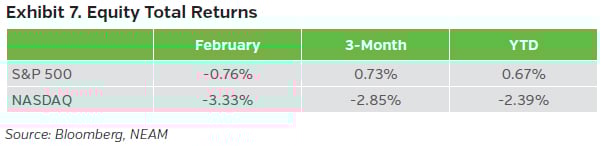
Equity Total Returns
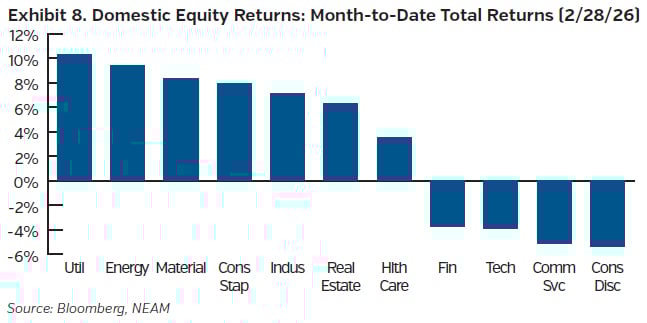
Equity market performance was mixed. For the month, the Dow posted a positive total return, while the S&P 500 and Nasdaq fell. Most fourth quarter earnings reports appeared solid, but many investors seemed to grow increasingly concerned about potential disruption, driven by AI advances, for software companies and other businesses.