


December Overview
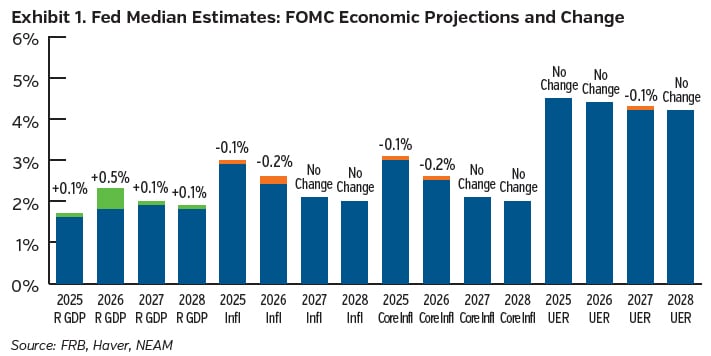
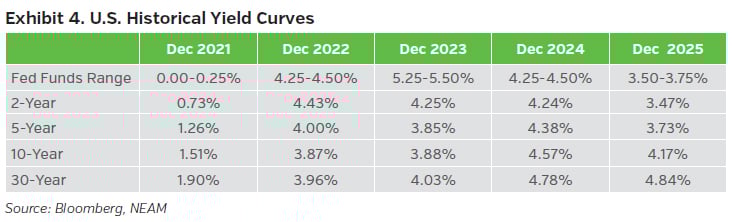
At its most recent meeting in December, the Fed reduced its benchmark rate by 25 basis points, bringing the range to 3.50-3.75%. With the cut, the Fed has now acted at its last three meetings. With the committee having moved the rate 175 basis points since September 2024, the decision to lower the rate did not appear to be a straightforward one. A total of nine committee members voted in favor of the cut. In contrast, one member voted for a more pronounced 50 basis point reduction, while the remaining two voted in favor of no change. Further division emerged in the Fed’s dot plot, which showed additional estimates for the Fed’s rate to remain unchanged and highlighting competing divisions of thought. Powell’s remarks during the press conference shared that views would differ when the Fed’s goals are in conflict, as committee members, while sharing the view that both risks remain, weigh the risks to inflation and employment differently, with corresponding differences in their policy approaches as a result. The related Fed minutes also shared the divergence of views, while pointing to a desire to slow the pace of any further easing while assessing future incoming data and the impact of policy actions taken to date. Indeed, median estimates from the summary of economic projections showed a further 25 basis points of easing in each of 2026 and 2027, respectively, reflecting in part the changes in the Fed’s median economic projections. These highlighted growth estimates increasing across the board, based in part on a more resilient consumer and AI contribution to business equipment investment, unemployment staying largely level with previous assumptions, and both headline and core inflation assumptions ticking down next year and leveling out thereafter. However, with the risk of both persistent, above-target inflation and a weaker labor market still present, and the cure for each potentially demanding differing approaches, the ability to achieve a consensus on future moves will become more challenging.
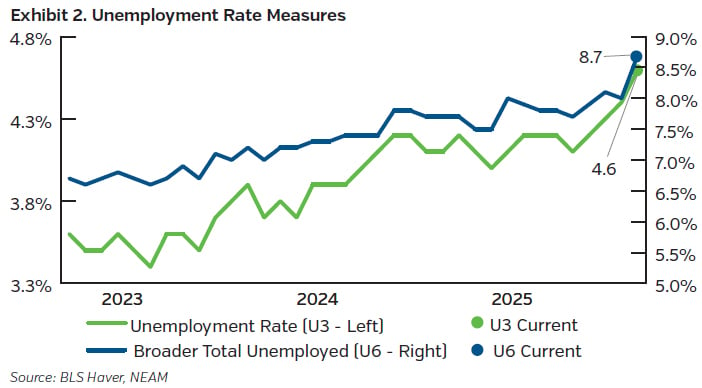
Nonfarm payrolls came in at +64K in November, beating market expectations. The additions followed a loss of -105K in October, driven by a sizable reduction in government workers. November’s gains remained dominated by healthcare jobs, with the construction sector being the other notable contributor to the upside. Conversely, several sectors saw declines, led by transportation and warehousing, and leisure and hospitality classifications. The unemployment rate increased to 4.6%, with labor force growth outpacing employment growth again, while a broader measure (U6) increased to 8.7%.
Consumer confidence remains under pressure, as people deal with the prospect of continuing inflation and weaker job prospects, although its weakness diverged from a stronger than expected Q3 GDP print, itself dominated by a health-related consumer spending on the services side.
Q3 GDP also showed business investment remains additive to overall growth, although with a tech focus. Despite gains in business equipment, the manufacturing industry overall added no contribution to the most recent industrial production numbers, after a decline in October, with the most recent industrial production numbers overall being dominated by an uptick in mining. Elsewhere, small business optimism and uncertainty ticked higher over the month. While many small businesses still hold concerns over the trajectory of the economy, the number of respondents expecting better sales contributed the most to the gain on the optimistic side, which despite its rise remains lower than at the end of 2024.
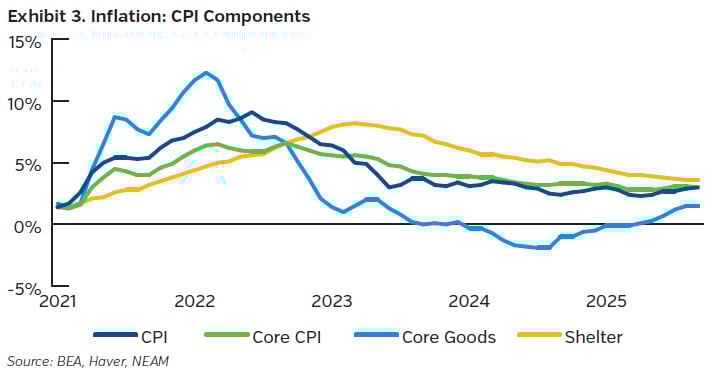
Inflation came in lower but was subject to some caveats, with the BLS unable to collect data for October. The BLS released data showing headline inflation came in at +0.2% for the two-month period between September and November, while posting a +2.7% gain for the year. On a core basis, the index also rose +0.2% for the same adjusted period, and +2.6% for the year. Looking at the seasonally adjusted constituent indices, core goods inflation fell to a +0.06% pace for the two-month period, while core services came in at +0.16%, with shelter slowing to +0.18%. Given the BLS’s impeded collection efforts, the market will wait for more data to see if the deceleration in price increases is indeed crystallizing. Notwithstanding this data holiday, annual core inflation had fallen from roughly 3.2% at the end of last year to 3.0% as of September, with core services dropping from 4.4% to 3.5%, while the tariff impacted core goods inflation segment reversed course, climbing from -0.5% to 1.5%, leaving the Fed aware that although progress has been made, there is more to do.
Capital Market Implications
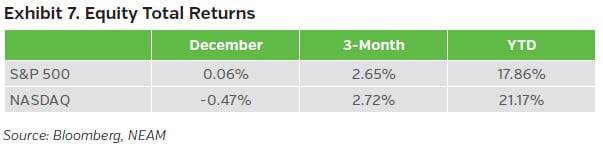
Tariff induced above-target inflation conceded to softening labor metrics, leading to the Fed lower rates three times in the latter part of 2025. For December, equity market performance was mixed, with the S&P 500 and Nasdaq lower, while the Dow gained. The Treasury curve steepened over the month as shorter term yields fell while longer term yields rose, and credit spreads inched tighter.
Capital Markets
Fixed Income Returns
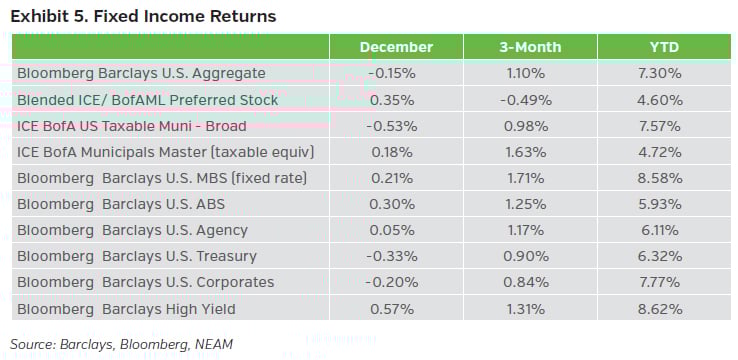
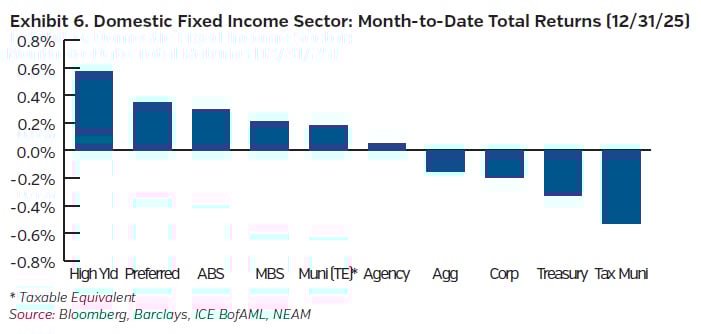
The Fed lowered its benchmark rate again in December, as it continues to navigate a course through a softening labor market and above target inflation. Short end rates declined and longer dated Treasury yields rose, while credit spreads inched tighter into month-end as markets wound down the year.
Equity Total Returns
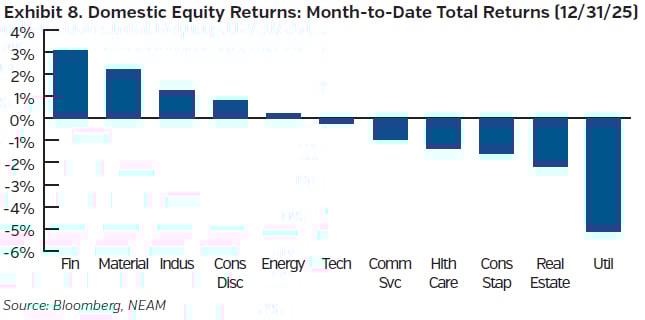
As investors digested another rate cut, limited and divergent data, and reduced liquidity into year-end, equity market performance was mixed during the month of December. For the year, the major domestic equity markets gained, boosted in part by renewed enthusiasm regarding AI investments, Fed rate cuts, and deregulation.