


January Overview
As the labor market stabilizes even while inflation remains above target, the Fed’s decision to keep the benchmark rate at 3.5%-3.75% reflects the Committee’s preference to wait for additional economic data before taking further action. Noting that the unemployment rate is steadying and payroll additions remain low, while upgrading the language related to the pace of growth to “solid” from “moderating,” the Fed still highlighted that inflation remains above their target. When viewed in the aggregate, the data led the Committee to decide to hold rates at their current levels until a clearer picture of the path of employment and inflation emerges. 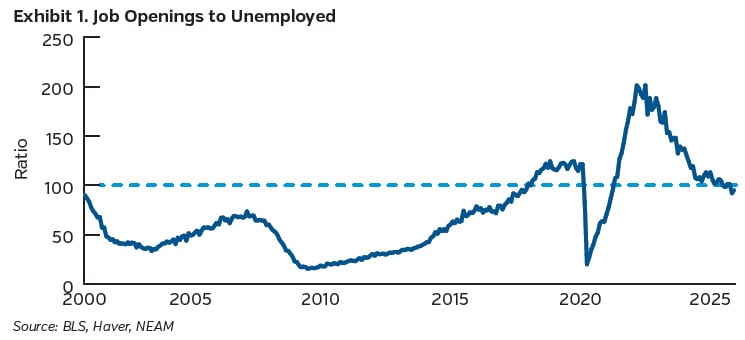
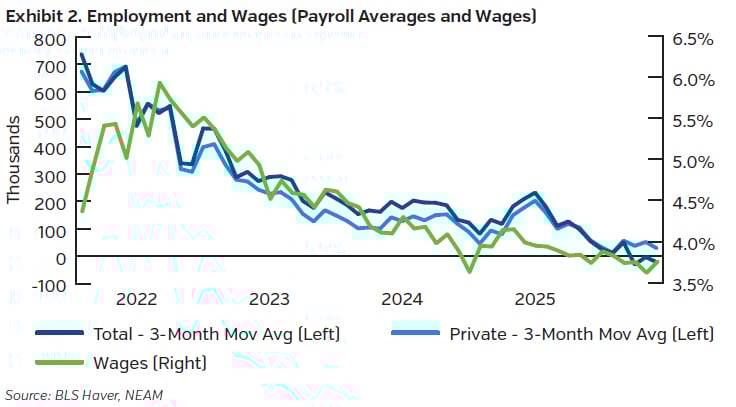
Job growth is tepid overall due to slower labor force growth, declining labor force participation, and cooling demand as noted by Powell in his post meeting press conference. JOLTS data over the month showed that job openings fell, along with hires, while layoffs also declined, suggesting firms held off on new hires while keeping existing employee ranks stable. After peaking above 2x post-COVID, the ratio of job openings to unemployed workers has fallen steadily to 0.9x, reaching levels not seen since early 2021. December nonfarm payrolls increased by 50K, but severe downward revisions to October and November jobs figures left the three-month average significantly weakened. Private payrolls added a modest 37K in December, bringing the three-month average to +29K. While hiring in healthcare and leisure/hospitality kept the private sector in positive territory, most other service and goods-producing sectors experienced job losses. Elsewhere, a drop in the labor force and a gain in the household employment area helped bring the unemployment rate down to 4.4%. Consumer sentiment surveys were mixed over the month, although both remain lower than the beginning of last year with consumers still digesting the softening labor market and higher prices.
Wage gains ticked up +3.76% relative to last year, while real earnings growth remains positive and retail sales increased at both the headline and core levels. Nominal and real personal spending had two good months in October and November, albeit at the expense of a further drop in the personal savings rate, as incomes failed to grow to the same extent as spending. The Fed’s Beige Book noted that holiday shopping drove an increase in consumer spending across most districts. However, a clear divide is emerging between income groups: lower-income consumers are becoming more price-sensitive and avoiding non-essentials, while higher-income consumers are spending more on luxury goods and experiences.
On the manufacturing side, activity across districts was mixed, as manufacturers from various industries dealt with weaker demand and increased costs from tariffs. National PMIs painted a similar, albeit more upbeat, picture. Industrial production rose +0.4% for the month, led primarily by a gain in utilities. The manufacturing component increased for the second month (+0.2%), though still negative for the fourth quarter overall. Away from manufacturing, small business optimism ticked up again, with the increase driven by improving expectations for business conditions, despite a weaker outlook for sales, while uncertainty receded.
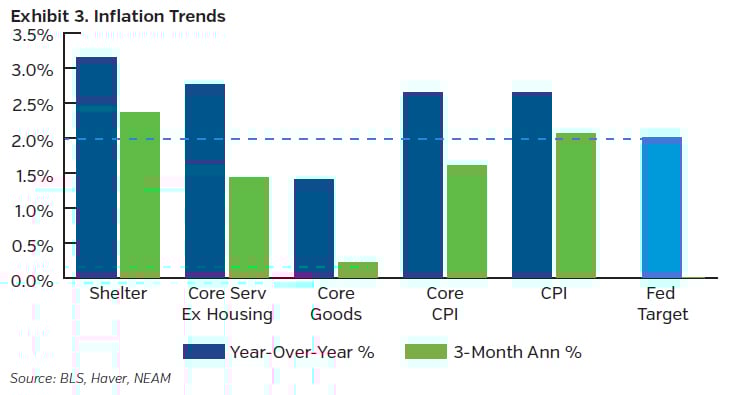
December’s CPI report headline inflation increased +0.3%, with food (+0.7%) and energy (+0.3%) adding to the core level increase of +0.2% for the month. On the core goods side, prices were encouragingly flat, with gains in apparel and household furnishings offset by declines in used vehicle prices and information technology. On the core services side, shelter ticked up again, rising to +0.4%, with rents and owner’s equivalent rent both up +0.3%, and lodging away from home increasing a sizeable 2.9% for the month. Other notable contributors came from the recreation services sector and airline fares, while education and communications weighed to the downside. The monthly figures left headline and core inflation steady at 2.7% and 2.6%, respectively, with core goods and core services remaining level at 1.4% and 3.0%, respectively, for the same period. The Fed’s preferred PCE gauge also came in at +0.2% for both the headline and core levels for the month, which equated to a +2.7% yearly comparison on both fronts. Economic indicators are trending in the right direction for the Federal Reserve. However, current levels still require attention and a continued focus on the trade-off between supporting the labor market and tackling above-target inflation.
Capital Market Implications
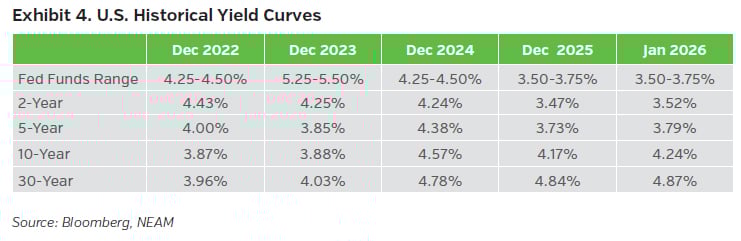
The FOMC signaled its intent to hold the policy rate steady at current levels given the current state of the economy, opting for more data before making further moves. Treasury yields notched higher, credit spreads tightened, while equity markets rose.
Capital Markets
Fixed Income Returns
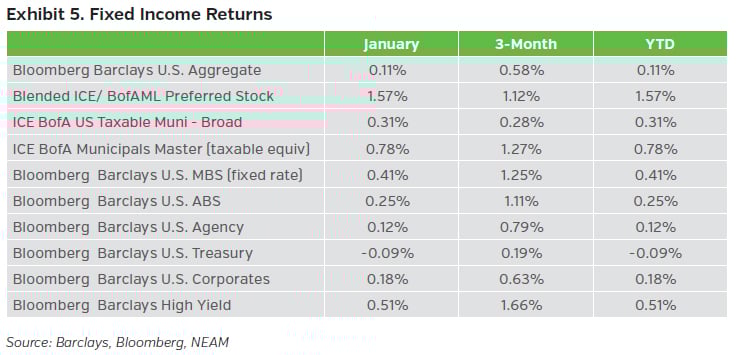
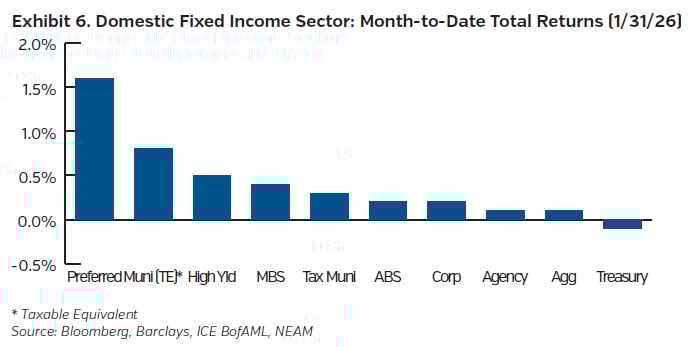
With the Fed highlighting a softer but potentially stabilizing labor market, solid expansion on the growth front, and still above target inflation, it held its benchmark rate steady. Treasury yields rose over the month while credit spreads tightened.
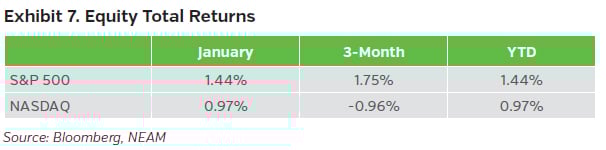
Equity Total Returns
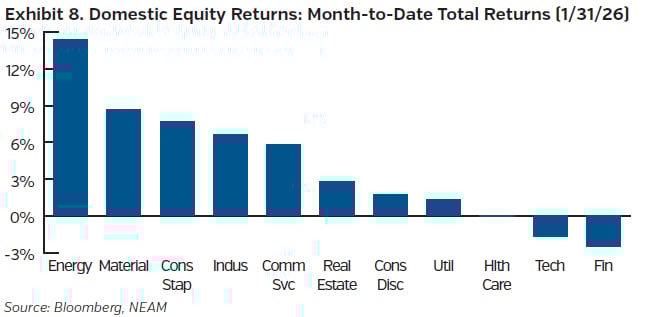
Despite increased volatility from geopolitical events, equity markets rose over the first month of year, as investors digested a Fed on hold given stabilizing economic data and solid growth. The S&P 500, Dow and Nasdaq all ended the month higher.