


July Overview
With a 9–3 vote, the Fed held its benchmark rate steady at the July meeting. In a brief statement designed to avoid signaling its rate outlook, the Fed again highlighted the economy’s “solid” growth and elevated inflation. However, unlike the previous meeting’s unanimous decision, the July vote revealed clearer dissent: three members favored raising the federal funds rate by 25 basis points. This dissent followed the previous meeting, when the minutes indicated that several members saw a case for higher rates but ultimately supported holding policy steady. At that time, the committee viewed inflation as a greater concern than labor-market weakness, noting that upside risks to price stability “remained elevated” while labor-market risks appeared to be “moderating.” For now, the committee can assess how the data evolve over the next two months before reconvening in September.
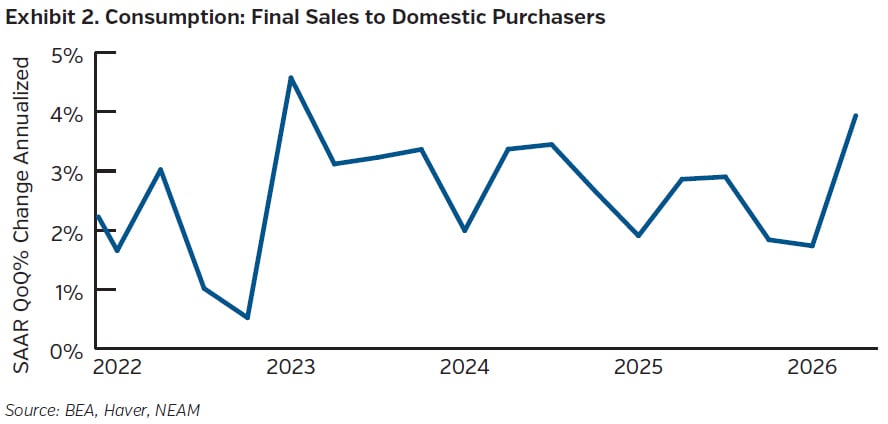
With the labor market in a more stable position, consumption remains resilient, although spending patterns are diverging across income groups. The June minutes noted growing pressure on lower-income households, while higher-income households continued to benefit from rising asset wealth. The University of Michigan and Conference Board measures of consumer confidence moved in opposite directions this month, but concerns about higher energy costs, broader inflation, job availability, and geopolitical uncertainty continue to weigh on sentiment. More recent New York Fed data show that delinquencies are moderating after rising, consistent with major U.S. banks’ reports of stable consumer credit performance. Consumer spending also remained strong in the second quarter, with personal consumption and private sales to domestic purchasers increasing at annualized rates of 3.2% and 3.9%, respectively. Consumers continued to spend as the savings rate edged lower to 2.7%.
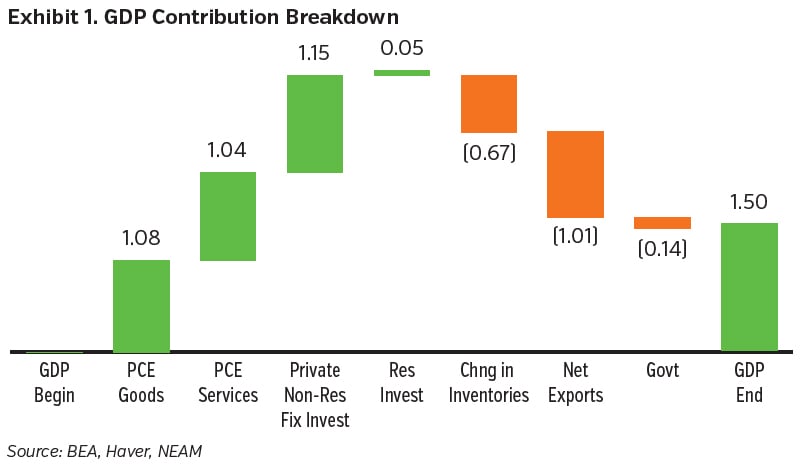
The NFIB Small Business Optimism Index improved, driven by stronger expectations for business conditions, sales growth, and capital spending. Although overall uncertainty declined, concerns about inflation and labor quality increased. Price pressures remained elevated, and more firms reported difficulty filling open positions. Industrial production rose 0.1% during the month, supported by 0.4% gains in both mining and utilities, while manufacturing output was unchanged. Durable-goods manufacturing continued to weigh on activity, although AI-related investment expanded at a healthy pace. More broadly, business investment has become an increasingly important driver of economic growth, supported in part by ongoing AI spending. This trend was reflected in an 8.4% annualized increase in non-residential fixed investment in the second quarter across multiple sectors.
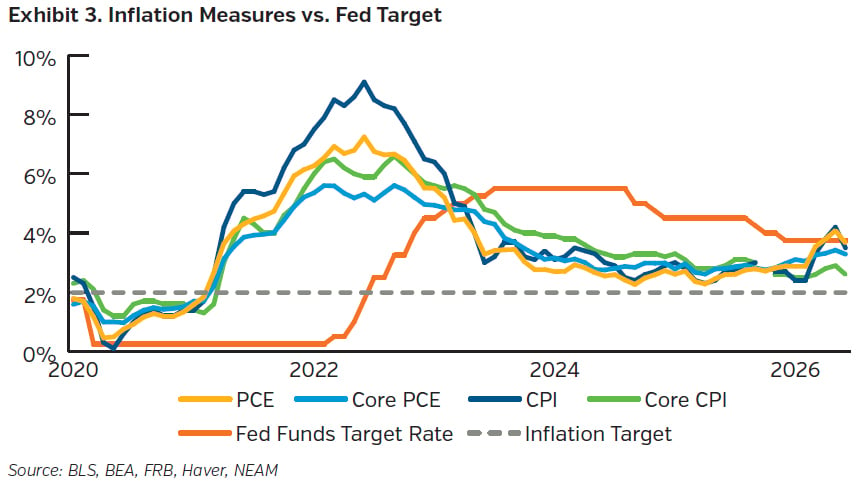
CPI inflation reversed course this month, declining for the first time since 2020. Falling energy prices pulled headline inflation lower, while core prices were essentially unchanged from the previous month. Headline prices fell 0.4% during the month, led by a 9.7% decline in gasoline. Core goods prices fell 0.1% for the second consecutive month, as declines in used cars, apparel, education and communication, and other goods weighed on the sector. Core services inflation also slowed, with declines in lodging away from home, airfares, and motor vehicle insurance contributing to the moderation. On a year-over-year basis, headline CPI slowed from 4.2% to 3.5%, while core CPI eased from 2.9% to 2.6%. PCE inflation measures also improved but remained above target, at annualized rates of 3.7% for headline inflation and 3.3% for core inflation.
Capital Market Implications
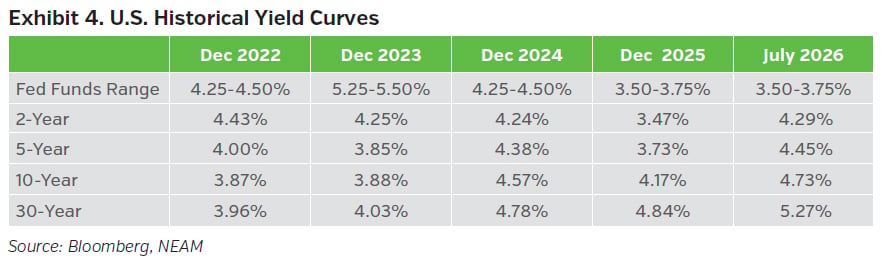
The Fed again left rates unchanged as underlying growth remained resilient, although a growing contingent of members believe additional policy restraint is necessary while inflation risks persist. Treasury yields rose, credit spreads widened, and equity performance was mixed.
Capital Markets
Fixed Income Returns
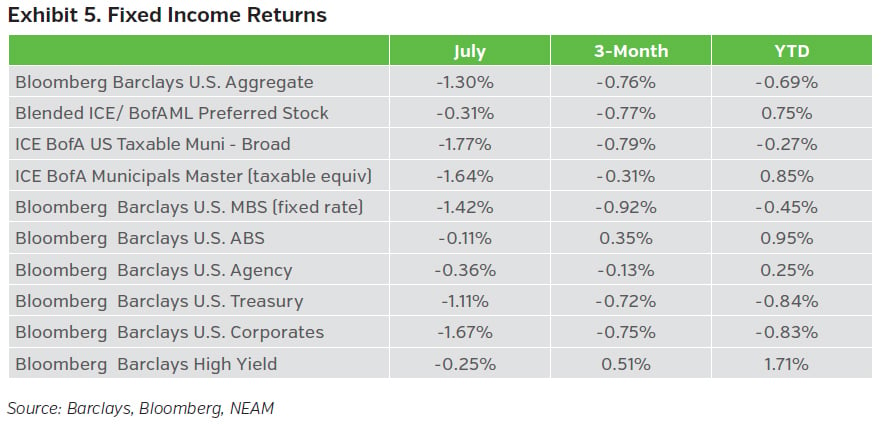
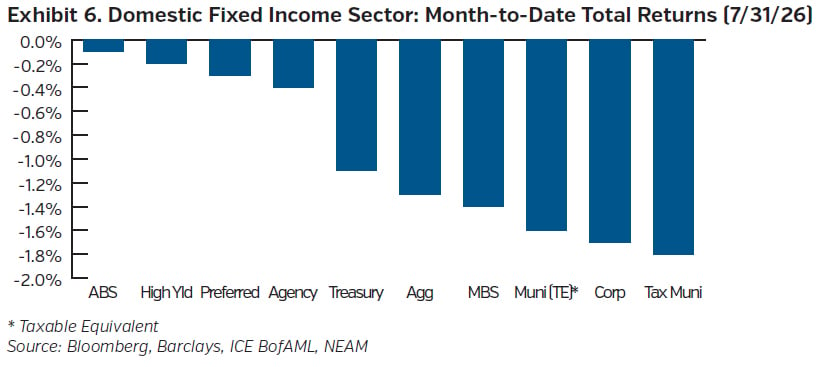
The Fed held rates steady as economic growth remains healthy, geopolitical conflict persists and inflation hovers above target. Treasury yields rose for the most part out the curve, while credit spreads widened modestly.
Equity Total Returns
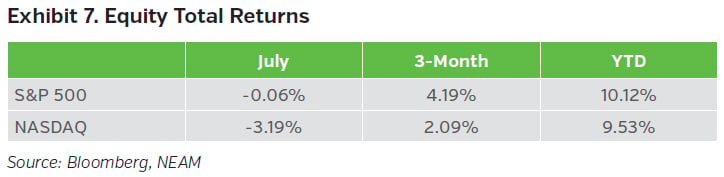
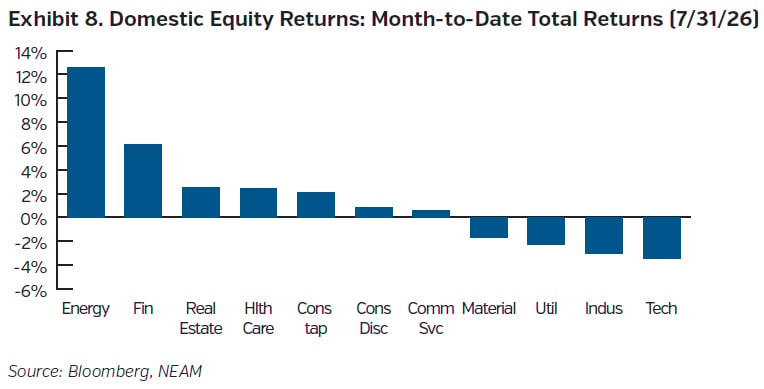
Equity performance was mixed in July. Companies generally reported positive earnings in the latter part of the month. However, after gapping higher earlier in the year, many stocks in the semiconductor subsector declined as some investors seemingly reassessed the AI investment cycle. The S&P 500 and Nasdaq ended the month lower, while the Dow gained marginally.