


March Overview
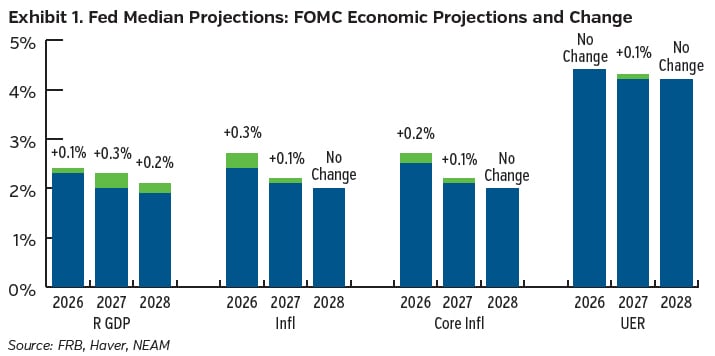
The Fed held steady at its most recent meeting, keeping its policy rate range at current levels. With the labor market stable but moderating, inflation still above target and geopolitical uncertainty rising, Chair Powell emphasized that future policy decisions would remain data-dependent. The Fed also commented that the economy appears on track, supported by “resilient” consumer spending and increasing business investment. Their median economic estimates showed GDP increasing over the next three years along with higher headline and core inflation. Unemployment projections remained relatively constant, with the rate expected to fall in 2027, albeit to a lesser extent than previously envisioned. Against the backdrop of rising Middle East tensions, uncertainty around these projections increased, particularly with respect to inflation. Despite this uncertainty, the median projection continues to reflect one rate cut in 2026, followed by an additional 25 basis point reduction in 2027.
Powell highlighted in his remarks that the confluence of softening labor demand, lower immigration and declining labor force participation is contributing to a moderating, but stable, labor market. Recent labor data have been volatile. March payrolls exceeded expectations at +178K, led again by healthcare, while February payrolls declined by 133K. Revised January figures rose to +160K, leaving the three‑month average at +68K. A sharper decline in labor force participation, which fell to 61.9%, contributed to a decline in the unemployment rate to 4.3%, down from 4.4% the prior month. Elsewhere, JOLTS data showed that job openings, hiring and quit rates fell over the month while layoffs rose modestly. Consumer confidence dipped to its lowest level of the year according to the University of Michigan, with the conflict in the Middle East tempering earlier optimism, as higher gas prices and corresponding inflation estimates increased, and expectations for personal finances fell. In contrast, the Conference Board’s number gained, although it remains on the lower side as people assess the job outlook and ongoing inflationary pressures. On the investment front, monthly industrial production increased a more measured +0.2%. While utilities declined, gains in mining (+0.8%) and manufacturing (+0.2%), helped drive the overall gain, with the latter led by gains in chemicals, motor vehicles production, electrical equipment and computers.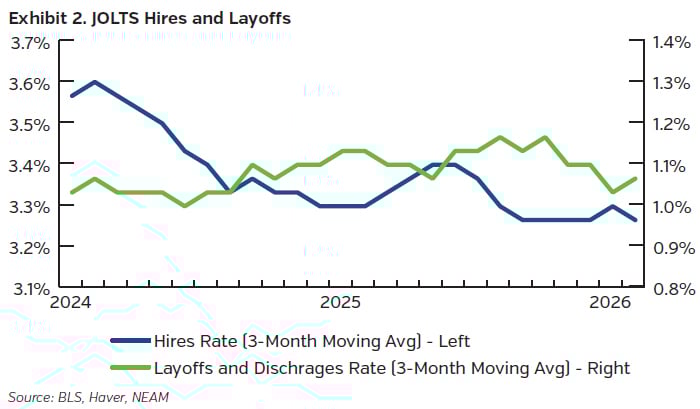
The ISM manufacturing PMI moved higher, remaining in expansionary territory, as respondents cited ongoing Middle East tensions and tariff uncertainty, while the prices paid index increased again to a level not seen since the summer of 2022. Small business optimism faded slightly though uncertainty declined over the month. Firms were slightly less optimistic about the future and less inclined to add jobs, but fewer raised prices despite compensation increases.
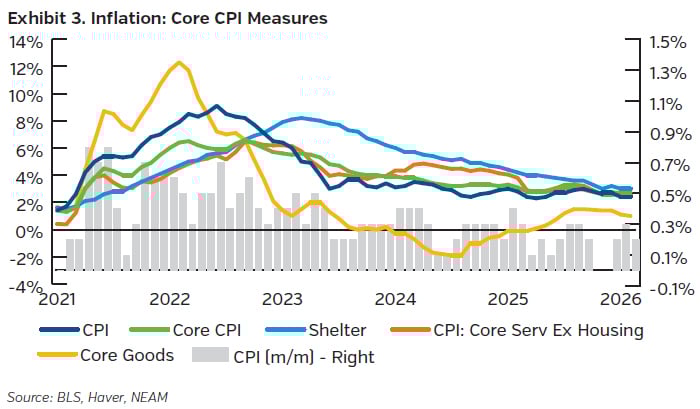
February’s CPI report was in line with consensus expectations. At the headline level, prices increased +0.3% on the month, slightly higher than last month’s pace. Food inflation ticked up to +0.4% over the month, while energy also gained after a retracement the month before. At the core level, prices increased +0.2%. Core goods price gains slowed to a +0.1% pace, with apparel, recreation and household furnishings weighing to the upside only to be countered in large part by lower education and communication services, medicinal drugs, and used vehicles price changes. On the core services side, prices remained level at +0.2% over the month. Shelter inflation was unchanged from the prior month, with slower gains in rents offset by a bump in hotel prices. For the year, the changes amounted to a 2.4% and 2.5% inflation rate at the headline and core levels, respectively. Meanwhile, core PCE levels came in at +0.4% for the month, and 3.1% for the year, respectively, in line with market expectations. Overall, while progress has been made, inflation remains above the Fed’s target. Recent upside risks to inflation from geopolitics, along with ongoing tariff-based pressure, present challenges, but the Fed takes some comfort in longer term inflation expectations which remain anchored. As a result, the Fed prefers to hold steady until it can receive more clarity in the data, acknowledging that risks to both sides of their dual mandate exist.
Capital Market Implications
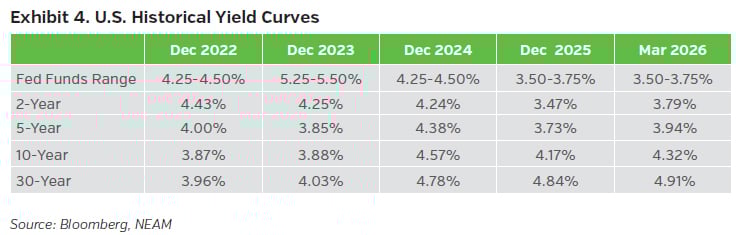
As geopolitical tensions escalated, the Fed held policy steady, balancing risks to both sides of its mandate. Treasury yields ultimately ended higher, with early inflation linked concerns only partially tempered by later month growth uncertainty, while equity markets fell.
Capital Markets
Fixed Income Returns
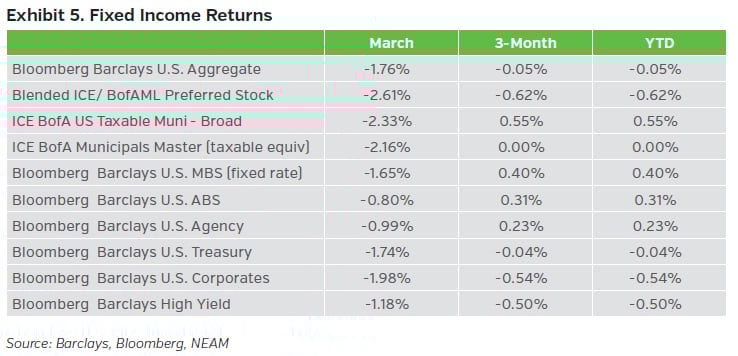
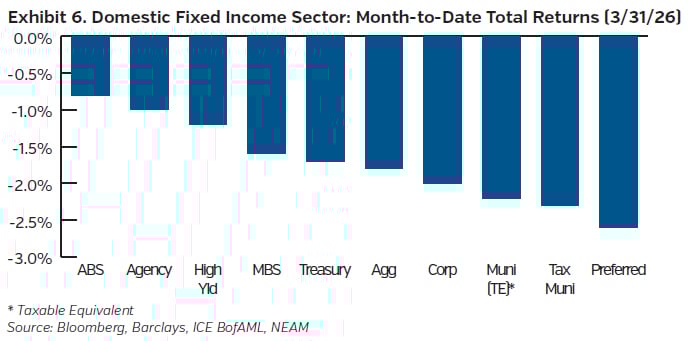
Heightened Middle East geopolitical tensions invoked a more cautious sentiment, while the Fed held steady as it balances its dual mandate. As inflation risks outweighed growth concerns, Treasury yields rose, while credit spreads widened amid elevated uncertainty.
Equity Total Returns
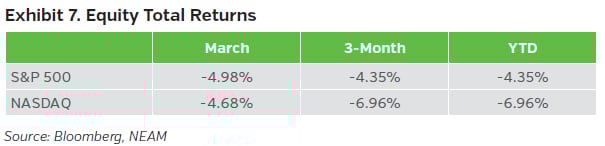
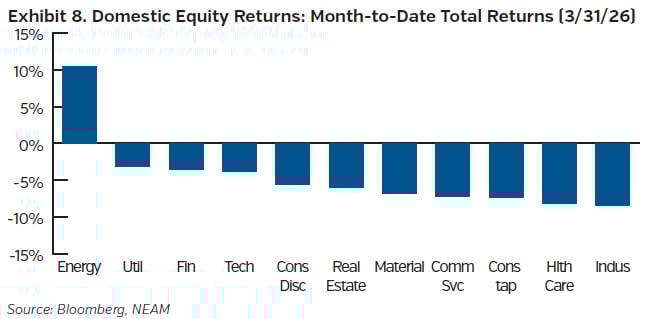
Equity markets sold off during the month as geopolitical tensions gave rise to a mix of inflation and growth concerns, despite corporate earnings showing resilience. The S&P 500, Dow and Nasdaq all ended the month lower.