



Strong Returns for Investment Grade Bonds in 2025
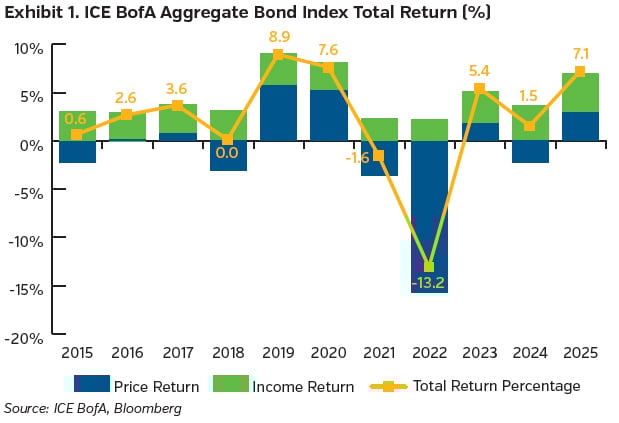
Investment-grade bonds staged a comeback in 2025, overcoming a year marked by significant economic policy uncertainty. The ICE BofA Aggregate Bond Index surged to a total return of 7.1%, a substantial improvement from 1.5% in 2024, with gains split equally between price appreciation and income. Interest rates dropped considerably across the curve: short- and intermediate-term maturities fell by about 70 basis points, the 10-year yield declined 40 basis points, while the 30-year yield remained stable.
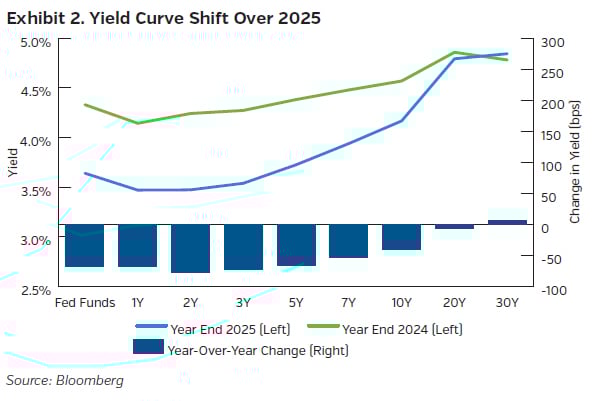
The moves set the stage for a bull steepening of the Treasury yield curve, resulting in a more normalized, upward sloping shape and the return of “term premium,” the additional compensation investors earn for holding longer-dated Treasuries.
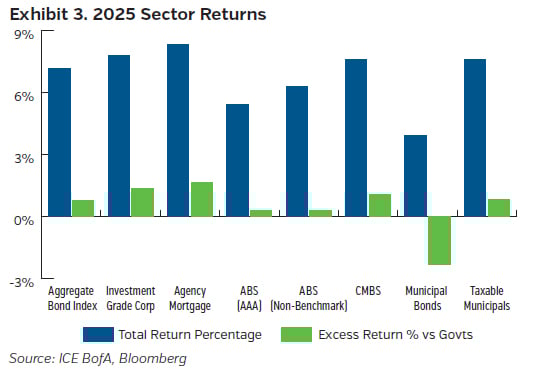
Investment grade sectors delivered positive total returns across the board as attractive all-in yields helped sustain investor demand and credit spreads were relatively rangebound. Longer duration sectors outperformed short-duration ones. The one exception was tax-exempt municipal bonds which initially lagged due to risk to tax exemption, heavy new issuance, and investor caution but later rebounded as those worries faded.
Looking Forward: Macro Backdrop
The U.S. economy enters 2026 on a resilient but cautious footing. Growth in the first half of the year looks set to bounce back after the government shutdown in the final quarter of 2025, and a step up in tax refunds to households, reflecting exemptions effective as of 1/1/25. AI related investment should remain robust, providing an ongoing source of support for business activity.
The outlook for the labor market is uncertain. While the number of job openings and unemployment are in balance, the pace of hiring (demand) has slowed, and restrictive immigration has decreased the supply of workers in certain sectors. With job growth slowing and inflation still above the Fed's target, the FOMC faces a delicate balance between full employment and stable prices. Reflecting this challenge, recent economic projections show that Fed members are divided on the forward path of the Fed Funds rate.
Policy developments could also rekindle volatility. A forthcoming Supreme Court ruling on tariffs imposed under the International Economic Emergency Powers Act (IEEPA) could reset the direction of U.S. trade policy. Meanwhile, fiscal pressures continue to mount: the federal budget deficit remains substantial, amplified by an ever-growing interest expense burden.
Credit conditions are generally favorable, supported by stable corporate fundamentals. Companies have so far navigated higher tariff related costs, though related inflationary pressures are still working their way through the system. Some pockets of stress are emerging among lower income borrowers, but these issues appear contained at present. As the U.S. moves into the mid-term election cycle, the administration may look for opportunities to soften the inflationary impact of tariffs, potentially offering relief to consumers.
Portfolio Implications: Neutral Duration Position
After the substantial rally in rates in 2025, and with the Fed in the final innings of its policy easing cycle, yields are expected to remain rangebound in the intermediate part of the curve, making a repeat of 2025 fixed income returns unlikely.
We recommend selectively taking advantage of longer maturity opportunities with the steepening of the yield curve but remain cautious in extending overall portfolio duration. One consideration is that U.S. budget deficits continue to add to the U.S. debt burden and are likely to regain visibility, as seen in other major global economies. Such concerns could lead to further steepening at the long-end of the yield curve.
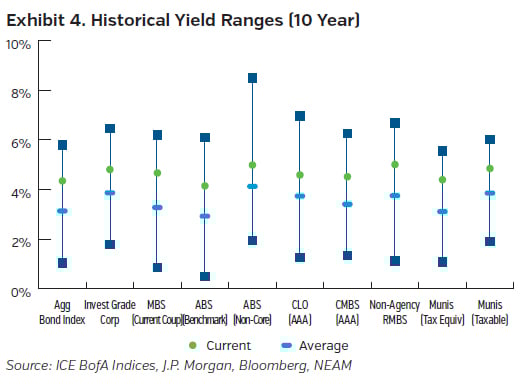
We are also cognizant of corporate credit spreads that are historically narrow, leaving valuations at risk for a reversion to more normalized (wider) levels. With a constructive view on the macroeconomic backdrop, we believe a neutral portfolio duration bias within our yield-driven total return strategy is most appropriate.
Finally, there is reason for optimism for fixed income investors. The income component of total return, historically the most stable part of fixed income returns, continued to grow in 2025, offering the benefit of compounded returns as reinvested coupon inflows boost overall income over time. And, while credit spreads are fully valued in the corporate sector, the opportunity to take advantage of attractive current yields in structured securities sectors, such as non-benchmark ABS, CLOs, and Non-Agency RMBS, remains compelling.
2026 Return Outlook
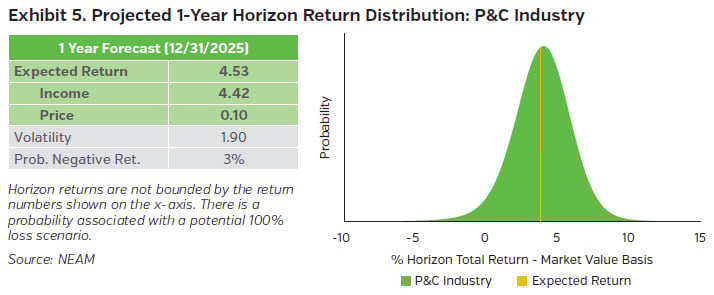
NEAM’s assumptions and views are captured in our projected total return methodology which, when applied to the fixed income portfolio of the P&C industry, results in a projected total return of 4.5% for 2026. With yields expected to remain rangebound, income is the prime contributor to total return for the upcoming year.
Key Takeaways
- The economic outlook for the first half of 2026 is constructive, supported by post government shutdown normalization, rising tax refunds, strong AI related investment, and a balanced, though slowing, labor market.
- A neutral duration position recommendation reflects the expectation for rangebound rates in the intermediate (4-7 yr.) part of the Treasury curve.
- Longer duration U.S. Treasury may be influenced by rising debt levels and lack of fiscal restraint, while corporate credit spreads appear vulnerable to a reversion toward more normalized spread levels.
- Allocations to structured securities, including ABS, CLOs, and Non Agency RMBS, can enhance income and diversify away from tighter, more fully valued investment grade corporate spreads.
The 2026 Projected P&C Fixed Income Return chart is based on an estimated aggregate P&C fixed income universe. Returns for this universe are forecasted under numerous interest rate and spread environments and then probability weighted based on our firm’s capital market views (i.e. historical returns, growth outlook, central bank policy, fiscal considerations) to create a hypothetical distribution of returns. These projected returns do not take into consideration the effect of taxes, changing risk profiles, operating cash flows or future investment decisions. Projected returns do not represent actual accounts or actual trades and may not reflect the effect of material economic and market factors. No representations or warranties are made as to the reasonableness of the assumptions made in these projections. Actual results will vary from any projected returns shown.