



Executive Summary
To understand how life insurers have navigated the recent period of elevated interest rates, we updated our analysis of the industry’s net investment spread (NIS)1 - the difference between the earned rate on invested assets and the estimated guaranteed rate credited to insurance contracts.2
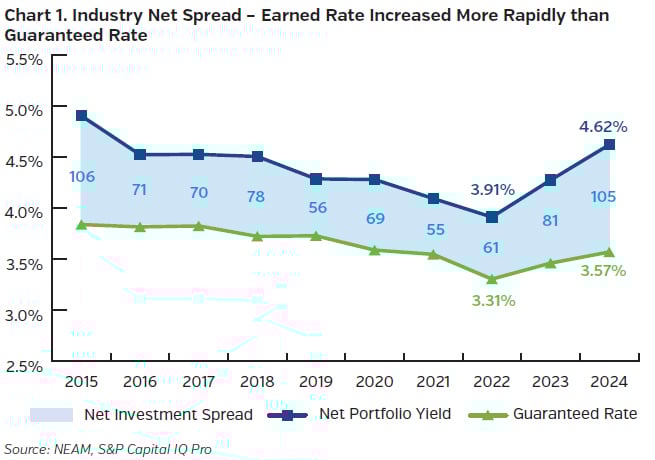
Since our last update, the investment landscape has shifted dramatically. From 2022 to 2024, the industry’s NIS rebounded by 44 basis points (bps), reaching 105 bps in 2024, the highest level since 2015. The share of companies with a positive NIS rose from 46% to 73%, a post-2008 high. Because life insurers typically invest in longer-duration assets, the boost to investment income from higher interest rates occurs gradually. Consequently, the benefit of the higher rate environment may not yet be fully reflected in investment income and could continue to grow in the coming years.
Despite this improvement, results continue to vary by company size and business mix. Large insurers (gross reserves >$15 billion) consistently maintained the highest proportion of positive net spreads, while small insurers (gross reserves <$1 billion) showed improvement in recent years but trailed their larger counterparts historically. NIS levels were generally higher among annuity-focused insurers compared with life-focused and diversified insurers.
Private equity (PE) ownership has become an increasingly prominent feature of the life insurance landscape, associated with higher, but more volatile, investment spreads compared to the broader industry. These annuity-focused insurers employ asset strategies that differ markedly from traditional life insurers, often emphasizing structured products over corporate bonds.
Widening Spread Driven by Rising Earned Rate
Chart 1 shows trends in earned rates (net portfolio yields3), estimated guaranteed rates (liability valuation rates), and NIS (i.e., the difference) from 2015 to 2024. After years of decline, the sharp rise in interest rates from 2022 to 2024 pushed earned rates from 3.91% in 2022 up to 4.62% in 2024, while guaranteed rates increased more modestly from 3.31% to 3.57%. As a result, the life industry’s NIS increased by 44 bps to 105 bps, the highest level since 2015, reflecting asset yields rising faster than liability valuation rates.
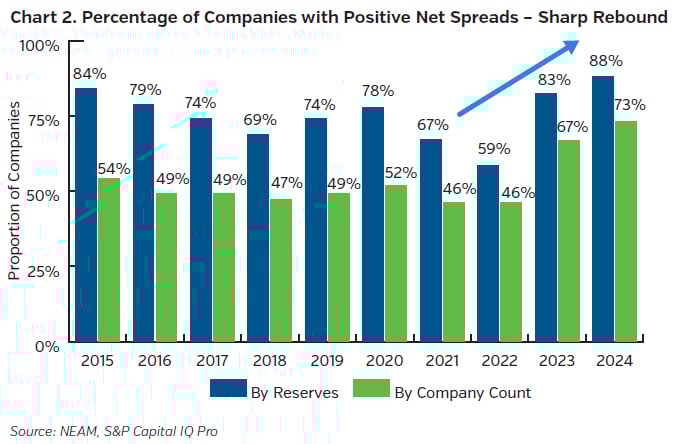
Chart 2 illustrates the rebound in life industry NIS by gross reserve distribution and company count. The proportion of industry gross reserves with a positive net spread declined from 84% in 2015 to 59% in 2022, before rebounding to 88% in 2024. By company count, the share of insurers with a positive net spread fell from 54% to 46% over the same period, then rose to 73% in 2024.
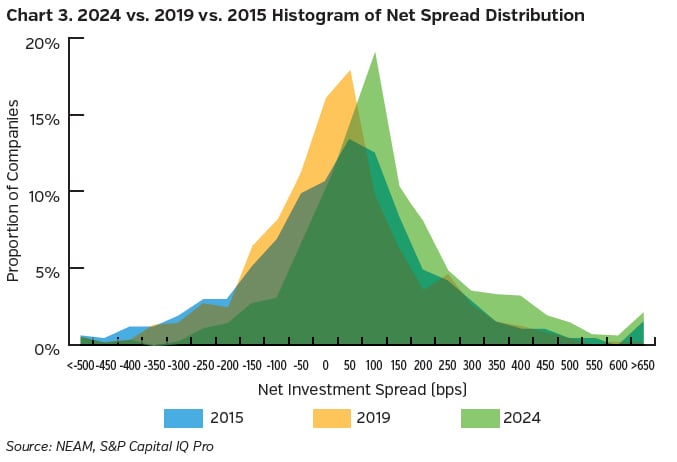
This improvement is also reflected in the distribution of spreads across companies. Chart 3 shows that after distributions shifted left toward zero from 2015 to 2019, the 2024 distribution reversed sharply, with more companies reporting spreads above 50 bps and a notable increase above 150 bps. Overall, the industry not only recovered from the 2019 lows but also surpassed 2015 levels at the higher end of the spread spectrum, suggesting a broad-based improvement in insurer profitability due to investments.
Large Insurers Gain Scale & Market Dominance
As highlighted in prior studies, NIS results have continued to vary significantly by company size. Over the past decade, larger insurers have represented an increasing share of total industry reserves. From 2015 to 2024, the share of reserves held by companies with over $15 billion in gross reserves grew from 75% to 82%, while firms with less than $1 billion declined from 2.0% to 1.3% (see Chart 4). This trend reflects both natural reserve growth, which increases the size of some companies, and industry consolidation. During the same period, the total number of companies in our defined life industry fell from 667 to 617, while those exceeding $15 billion in gross reserves grew from 48 to 63. These shifts underscore the growing dominance of large insurers and warrant a closer look at how investment spread outcomes differ by company size.
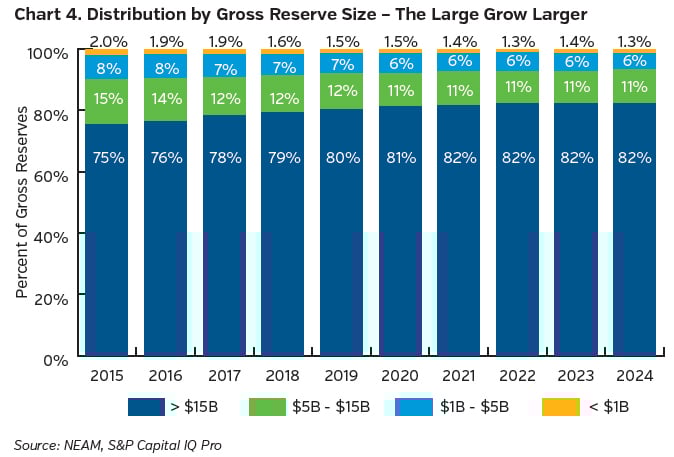
Chart 5 highlights how company size has influenced NIS over the past decade. Large insurers (dark blue; with gross reserves >$15 billion) consistently maintained the highest proportion of companies with positive net spreads each year. Conversely, small insurers (yellow; with gross reserves <$1 billion) struggled, with fewer than half showing positive net spreads between 2015 and 2022. Mid-sized insurers (light blue, green; with gross reserves $1 billion–$15 billion) experienced a gradual decline through 2022, though most continued to maintain positive spreads. By 2023 and 2024, the industry as a whole saw gains and a broad-based recovery across all size segments.

Annuity-Focused Insurers Outperform Peers
In addition to variation in NIS results by company size, we observed meaningful differences based on business focus. For this analysis, life insurers are classified as:
- Life-focused: Over two-thirds of statutory reserves classified as life business
- Annuity-focused: Over two-thirds of statutory reserves classified as annuity business
- Diversified: All others
Chart 6 shows that over the past decade, the share of industry gross reserves held by annuity-focused insurers has grown, while the share held by diversified insurers has declined. As of year-end 2024, life-focused, annuity-focused, and diversified insurers represented 30%, 41%, and 29% of industry gross reserves, respectively, with annuity-focused insurers gaining share over time.
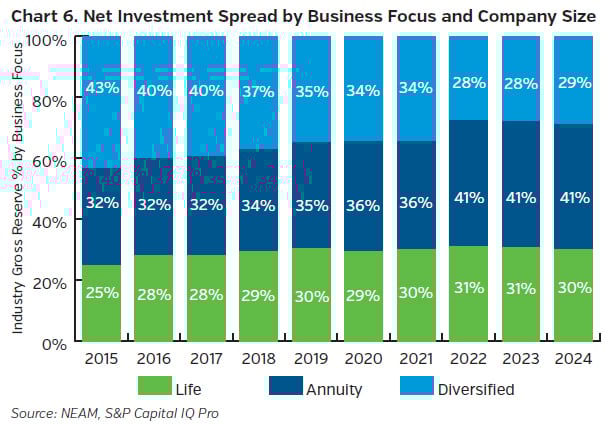
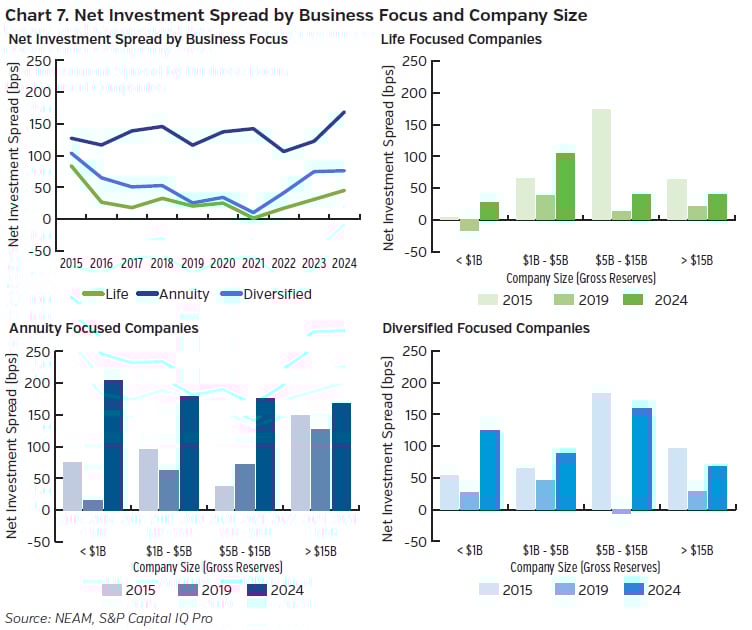
Chart 7 compares NIS by business focus and company size across the life industry. From 2015 to 2024, annuity-focused companies consistently achieved the highest average NIS among the three business types, with spreads rebounding from a low of 106 bps in 2022 to 169 bps in 2024. Within this group, large companies (with gross reserves >$15 billion) not only maintained higher spread levels but showed greater stability compared to smaller annuity writers. Life-focused insurers showed some recovery from their 2021 low but reached only 45 bps in 2024. Diversified insurers experienced a steadier recovery, with spreads rising to 76 bps in 2024.
Private Equity (PE)-Owned Insurers: Annuity Focus & Alternative Asset Strategies
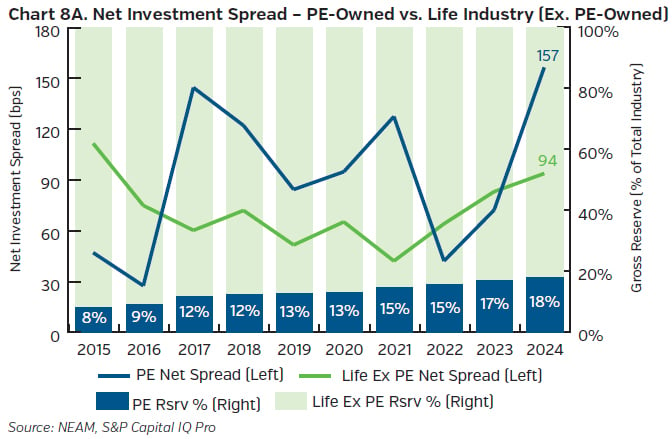
One potential factor behind the outperformance of annuity-focused companies is the growing presence of PE-owned insurers4 in the life industry. Many of these insurers specialize in annuities: as of 2024, annuity-focused companies represented 88% of gross reserves among PE-owned insurers. Over the past decade, their share of industry gross reserves more than doubled, from about 8% in 2015 to 18% in 2024.
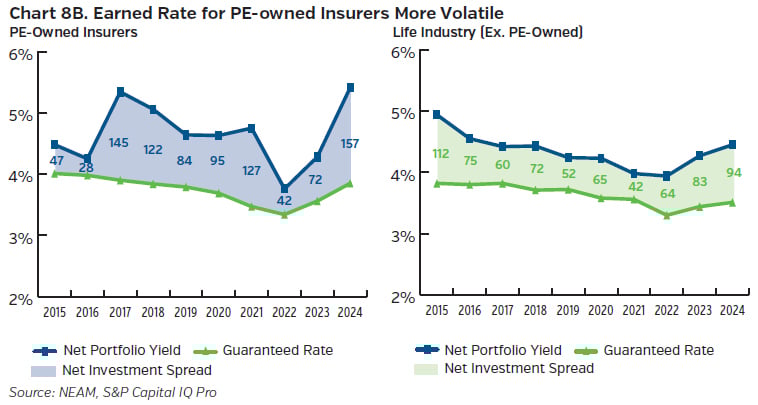
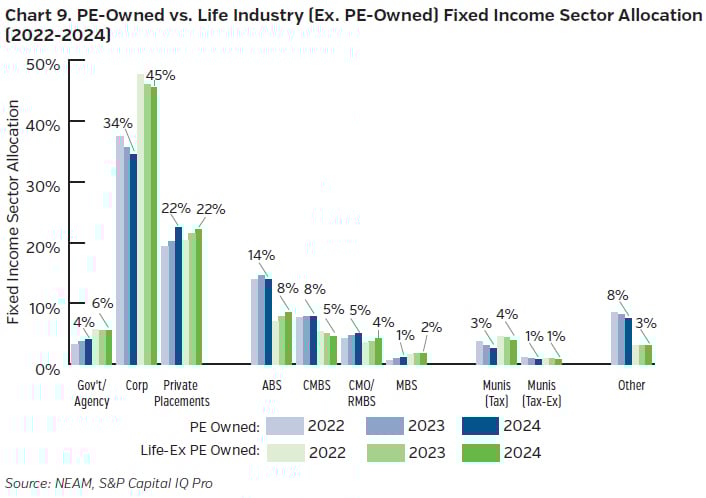
Charts 8A and 8B show that between 2015 and 2024, PE-owned insurers maintained higher NIS than the broader life insurance industry, though with noticeably greater year-to-year volatility. Guaranteed rates for both groups tracked closely, ranging between 3.3% and 3.8%, as shown by the green lines (Chart 8B). The key difference lies in earned rates, depicted by the blue lines (Chart 8B): while industry peers saw modest and stable earned rates of around 4.2% to 4.5%, PE-owned insurers experienced wider fluctuations, from a low near 3.8% in 2022 to a high of 5.4% in 2024. As a result, NIS for PE-owned insurers ranged from 28 bps in 2016 to 157 bps in 2024. Chart 9 highlights differences in fixed income sector allocations between PE-owned insurers and the broader life industry, with PE-owned insurers consistently showing higher exposure to structured products and lower exposure to corporate bonds over the past three years.
KEY TAKEAWAYS
- The life insurance industry’s NIS rebounded sharply from 2022 to 2024, reaching 105 bps, the highest level since 2015. This was driven by earned rates rising faster than guaranteed rates.
- Large insurers (gross reserves >$15 billion) consistently maintained the highest proportion of positive net spread every year, while small insurers (gross reserves <$1 billion) tended to struggle. However, by 2023 and 2024, all cohorts experienced significant recovery in their NIS.
- Annuity-focused insurers consistently and meaningfully outperformed life-focused and diversified peers, with larger annuity-focused firms achieving higher and less volatile investment yields compared to smaller counterparts.
- PE-owned insurers have typically generated higher but more volatile investment yields than the broader industry. These annuity-focused writers tend to overweight structured products and underweight corporate bonds relative to traditional insurers.
We welcome your feedback on this analysis and related topics!
Endnotes
1 General ReView – “Life Industry Net Investment Spread: Declining but Stabilizing.” February 2014. Perspectives – “Life Industry’s Net Investment Spread: Have We Reached the Bottom?” January 2017. Perspectives – “Life Insurance Industry’s Net Investment Spreads: Who Suffers the Least?” April 2021.
2 Statutory valuation interest rates are used to proxy minimum investment returns (i.e., guaranteed rates) that life insurers must earn to maintain profitability.
Net Investment Spread = Net Portfolio Yield – Guaranteed Interest Rate
Net Portfolio Yield = 
The guaranteed interest rates are approximated by the weighted-average valuation interest rate derived from statutory financials, Exhibit 5: Aggregate Reserve for Life Contracts. Guaranteed rates are estimated using gross reserves, which exclude the effects of ceded reinsurance, as Exhibit 5 only shows reinsurance ceded only by aggregate contract type.
3 The net portfolio yield reflects investment returns from both affiliated and unaffiliated investments.
4 A private equity (PE)-owned insurance company is defined as a life/annuity insurer whose ultimate parent company name corresponds to a private equity firm or an entity backed, controlled or significantly influenced by private equity capital. This includes both traditional PE funds and PE-adjacent entities identified through ownership structure or strategic alignment. Manual judgment may be applied in cases where classification is not straightforward. In 2024, 81 of the 617 life insurers were classified as PE-owned.