



During his Senate confirmation hearing, Federal Reserve Chair nominee Kevin Warsh called for “regime change” at the Fed to restore its credibility. The June 17 FOMC meeting gave markets a first glimpse of what that could look like: a more hawkish tone, a renewed focus on the inflation mandate, and a decisive step away from the forward-guidance-heavy playbook of the post-financial-crisis era. In this new regime, investors may receive fewer signals from the Fed, leaving markets more vulnerable to sharp reactions when key economic data or policy pronouncements surprise.
A Deliberate Shift in Communication Framework
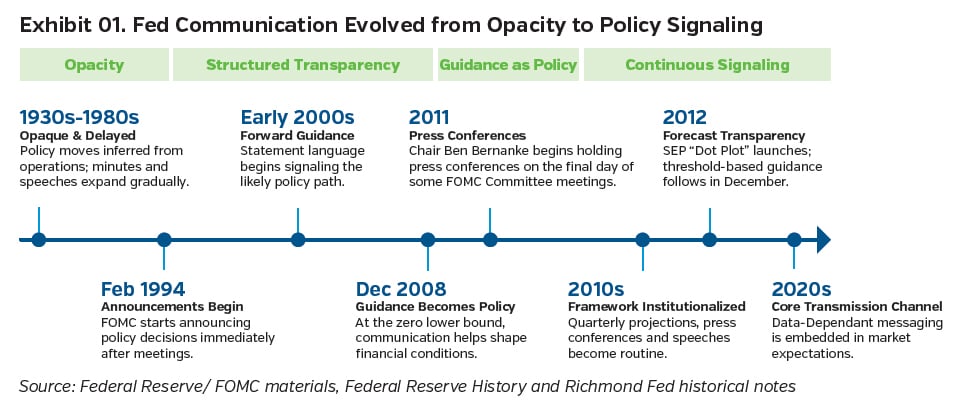
Central bank communication has long shaped market perceptions of policy risk, but the Fed’s approach has evolved. Under Paul Volcker in the 1980s, the Fed offered little hand-holding and rebuilt credibility through forceful action to tackle inflation. After the Global Financial Crisis, the pendulum swung the other way. Bernanke, Yellen, and Powell leaned into transparency, using the “dot plot,” detailed statements, and forward guidance to anchor expectations and dampen market disruption.
The Warsh regime looks ready to pull that pendulum back. The shortened June statement, lack of forward guidance, and reduced emphasis on projections point to a more restrained communication posture. This is not a full return to Volcker-era opacity, but the direction is clear: the Fed appears less inclined to cushion market reactions with words and more willing to let investors price the data for themselves.
Rebuilding the Fed’s Operating Framework
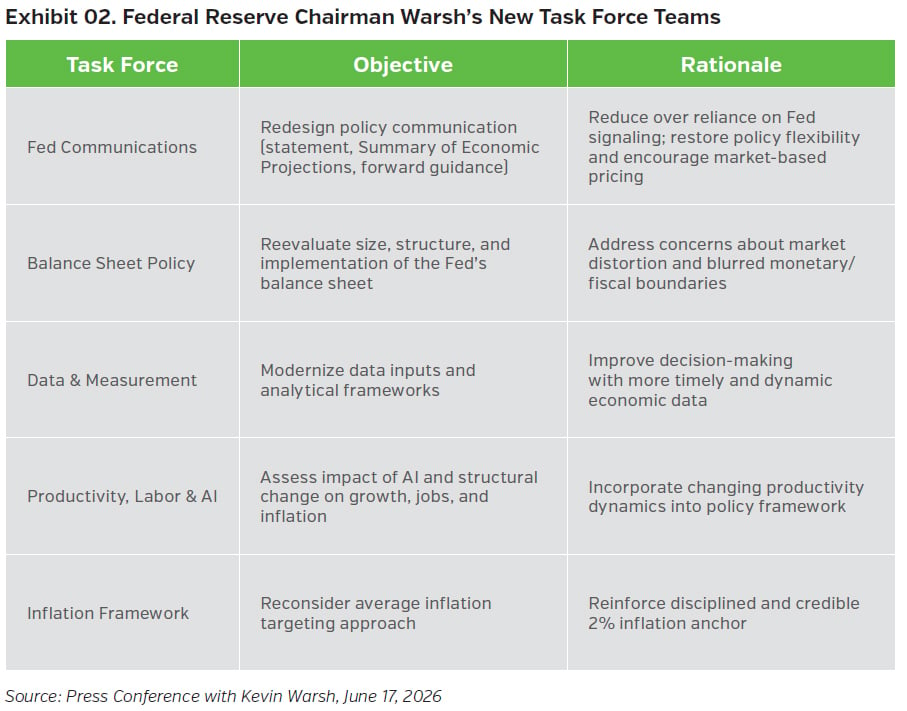
The emerging Warsh framework is not just a communications reset. The task-force agenda below points to a much broader rethink of how the Fed operates, from policy messaging and balance sheet strategy to data, measurement, AI-related productivity shifts, and the inflation framework itself. The scope of the agenda suggests these changes could amount to a meaningful redesign of how the Fed communicates, analyzes the economy, and implements policy.
Hawkish Undercurrents in the Policy Outlook
The Fed left rates unchanged at the June meeting, but the projections were hardly benign. Half of FOMC participants expected at least one 25 basis point hike in 2026, signaling that the inflation fight is not yet safely in the rear view mirror. Warsh did not submit his own projections, but his emphasis on the Committee’s goal to “deliver price stability” made the message clear: the inflation mandate is moving back to center stage while the labor market still looks broadly stable.
That pivot is arriving against a messy backdrop of supply-driven inflation shocks and persistent geopolitical and economic policy uncertainty, leaving the Fed with a difficult balancing act. Warsh’s emphasis on delivering price stability, combined with still-solid growth and labor-market conditions, suggests the Fed may be less inclined to ease preemptively if growth slows, raising the risk that restrictive policy eventually weighs on credit creation, business investment, and broader activity.
What It Means for Capital Markets
For markets, less policy visibility creates more room for volatility. A Warsh Fed that offers fewer signals and leans harder on realized data would remove an important anchor for expectations, widening the range of rate outcomes, lifting term premium, and making inflation, labor-market, and policy surprises more market-moving. With respect to equity markets, a Warsh Fed is also less likely to talk down markets (à la Greenspan’s “irrational exuberance”) by expressing opinions about valuations, which could extend rallies or add to market volatility.
Kevin Warsh has also signaled a preference for a smaller Fed balance sheet to remove distortions caused by extended periods of quantitative easing. A smaller Fed balance sheet could add pressure by reducing the liquidity cushion that helped soften stress in the post-crisis and pandemic periods. As private investors absorb more Treasury and agency supply, markets may demand greater compensation for duration, funding, and liquidity risk, and weaken confidence in the Fed “put” (the perception that the central bank will step in to support markets during periods of stress).
The impact of any resizing of the Fed balance sheet will depend on execution. If runoff is paired with bank liquidity and capital recalibration that allows private markets to intermediate smoothly, the Fed may shrink its footprint without tightening conditions too aggressively. Without that offset, rates markets could be more vulnerable to sharp repricing around Treasury auctions, funding stress, or financial shocks.
Key Takeaways
• Less communication, fewer guideposts: The Warsh Fed appears to favor less forward guidance and greater reliance on realized data and policy action.
• Price stability re-centered: The Committee’s messaging reinforces a renewed commitment to the 2% inflation objective.
• Fed operating structure under review: Newly created task forces point to changes in communications, balance sheet policy, data inputs, and the inflation framework.
• Higher market volatility: Fewer signals from the Federal Reserve could make markets more reactive around FOMC meetings, key data releases, and shifts in Fed rhetoric.