


3Q 2026 UK Economy Overview
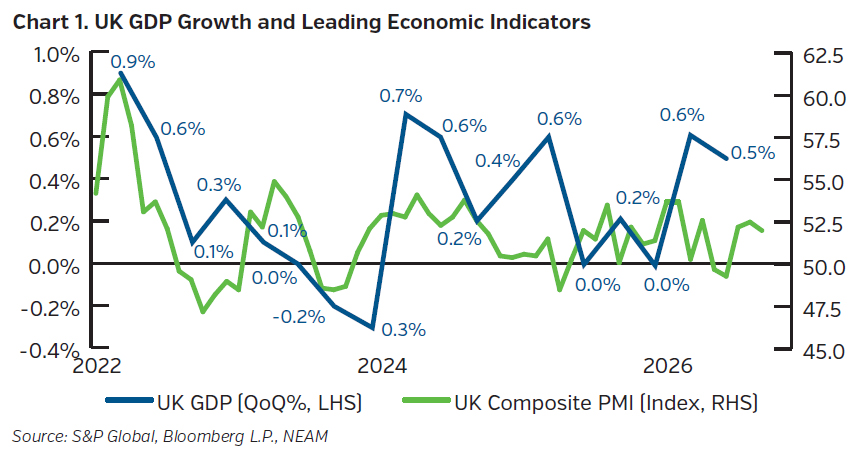
Growth had been expected to slow following a stronger-than-expected start to the year, with GDP expanding by 0.6% QoQ in the first quarter. However, despite headwinds from higher energy prices, elevated borrowing costs, and continued geopolitical uncertainty, economic activity exceeded expectations, with second-quarter GDP growth revised higher to 0.5% QoQ from an initial estimate of 0.4%. The more timely, but more volatile, monthly GDP series also suggested the economy entered the third quarter on a firmer footing, with the Office for National Statistics (ONS) estimating output increased by 0.4% MoM in July, well above consensus expectations for no growth. Within the Q2 details, the expenditure breakdown showed that business investment (+1.8%) and consumption (+0.3%) were the main drivers of the gain, each adding 0.2 percentage points to the headline print. Consistent with the strength in business investment, July's monthly data suggested that AI-related activity may have provided an additional tailwind to economic growth. Computer programming, consultancy and related activities rose by 3.5% MoM, contributing 0.1 percentage points to the overall rise in GDP. The ONS noted that many of the businesses which reported the highest turnover in this category are linked to AI and cloud computing.
Forward-looking indicators and survey data also remained constructive and suggested the economy entered the second half of the year with more momentum than had been anticipated earlier in the year. The S&P Global UK Composite PMI rose to 52.5 in August from 52.2 in July, its highest level since April, before dipping to 52.0 in September, but still signalling a moderate expansion of business activity volumes. Business surveys suggested that improving domestic demand and increased spending supported activity through the summer months, while business confidence recovered from the lows seen following the escalation of the Middle East conflict. Reflecting the stronger-than-expected data flow, the Bank of England (BoE) staff subsequently revised their estimate of Q3 GDP growth to 0.4%, four times the pace incorporated in the July Monetary Policy Report (MPR).
Inflation in the UK reaccelerated during the quarter as higher energy costs fed through to households following July's increase in the Ofgem price cap. Headline CPI rose to 2.9% YoY in July from 2.6% in June, before increasing further to 3.1% in August, marking the second consecutive monthly rise in the annual inflation rate. Household energy bills were a significant source of upward pressure, while transport costs, particularly motor fuels, also contributed to the increase. Higher energy prices also fed into inflation expectations, with the Citi/YouGov measure of one-year-ahead household inflation expectations rising to 3.9% in August from 3.4% previously. However, measures of underlying inflation remained more benign. Core CPI was unchanged at 2.6% in both July and August, while services inflation held at 3.4% in August. There also remained limited evidence of the broad-based second-round effects that characterised the inflation shock of 2022. According to the BoE, direct energy effects accounted for 0.7 percentage points of the 1.1 percentage point deviation of CPI inflation from target in August, with motor fuels accounting for the majority of that contribution.
The labour market continued to show signs of slack during the quarter, despite the stronger-than-expected activity data. The unemployment rate held at 4.9% in the three months to July. The BoE had expected the rate to be above 5% by the end of Q2, and the Bank currently expects the unemployment rate to rise gradually to 5.0% in 2026 Q3 and 5.1% in Q4. That rise is expected to reflect continued weakness in hiring more than an increase in job losses. While Labour Force Survey data has been somewhat stronger than the BoE’s expectations, payroll data from HMRC continued to point to weakness. The number of employees on payrolls dropped by 26,000 in August and by 67,500 on a rolling three-month basis. Payrolls are prone to significant revisions, but the series has shown job losses in six of the first seven months of data so far in 2026. Regular pay growth in the private sector, the measure most closely tracked by the BoE, remained at 2.9% in each of the last three releases and has declined from the 3.4% growth rate seen at the end of 2025.
At its September meeting, the Bank of England voted by a margin of 6-3 to leave the Bank Rate unchanged at 3.75%, with three members continuing to favour a 25bp increase. The decision followed a quarter in which headline inflation moved higher, growth proved more resilient than expected, and household inflation expectations increased. Despite these developments, the MPC judged that there remained little evidence of material second-round effects in wage and price setting. The Committee noted that the risks to the inflation outlook had become more skewed to the upside relative to the July Monetary Policy Report, particularly if higher energy prices persisted for longer than anticipated. Energy prices ended the quarter closer to the conditioning assumptions underlying the Bank's more adverse inflation scenarios presented in July, contributing to the MPC's assessment that inflation risks had become more skewed to the upside. Alongside the rate decision, the MPC announced changes to its quantitative tightening (QT) programme, voting unanimously to continue reducing the stock of gilt holdings held for monetary policy purposes, while pausing all active bond sales until April 2027. The Bank also outlined a revised approach to future gilt sales, with longer-dated bonds excluded from active sales and reductions in holdings increasingly driven by maturities. The change was viewed positively by gilt investors and initially supported longer-dated government bonds following the announcement. However, that rally proved short-lived as concerns surrounding higher energy prices, inflation risks, and rising global bond yields re-emerged later in the month.
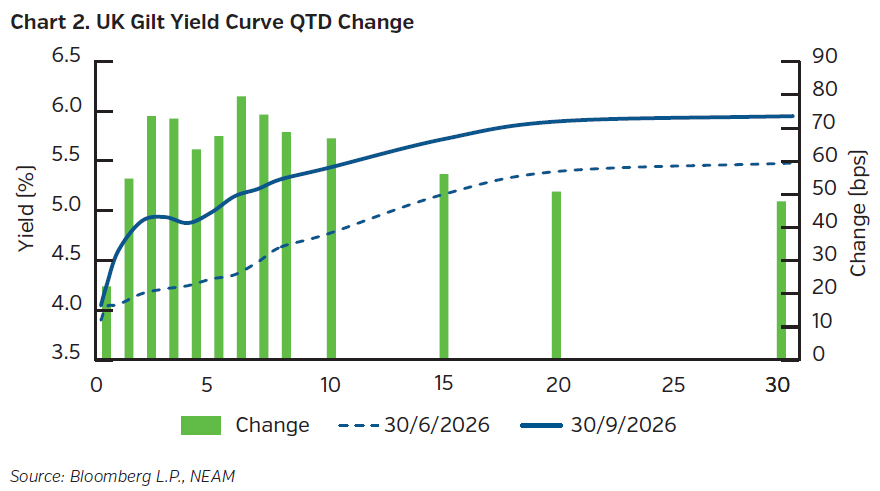
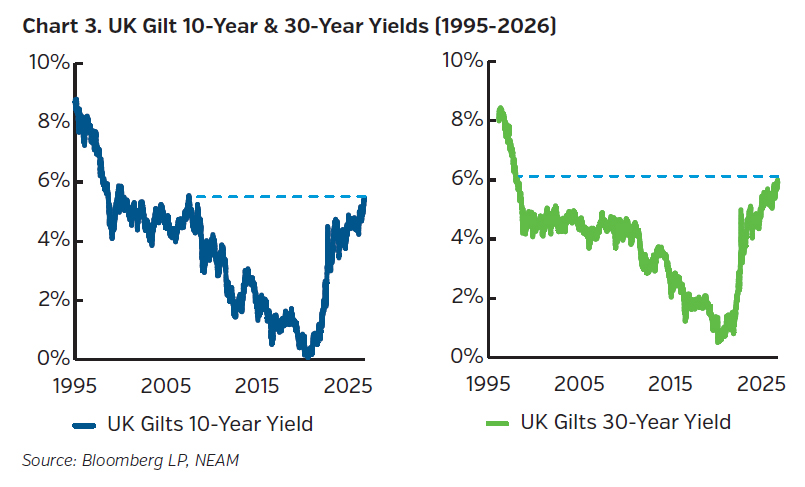
UK government bond markets came under sustained pressure during the third quarter as investors increasingly priced the risk of a more prolonged inflation shock and gilts participated in the global bond sell-off throughout the quarter, with long-dated maturities bearing the brunt of the weakness. As a result, several benchmark gilts ended the quarter with yields at multi-decade highs, with the 10-year gilt yield reaching its highest level since 2007 and the 30-year yield rising to its highest level since 1998. Amid the sell-off, the gilt index recorded a total return of -2.82% in Q3.
Sterling credit markets proved relatively resilient despite the rise in underlying yields, with sterling investment-grade spreads remaining broadly contained. The ICE BofA Sterling Corporate Index finished Q3 at 87bps, albeit 8bps higher than the lows of 79bps reached in August and September. Sterling also held up relatively well during the quarter, as stronger-than-expected growth and the prospect of further monetary tightening offset concerns surrounding higher energy prices and rising borrowing costs. While GBP/USD was broadly unchanged over the period, sterling appreciated modestly against the euro as investors increasingly viewed the UK economy as more resilient than had been anticipated earlier in the year, given growing concerns surrounding fiscal sustainability in France and the potential for wider contagion risks across European government bond markets.