



Fixed income investors today face a somewhat unusual market backdrop. Absolute yields on investment grade bonds are attractive compared with the low-rate environment that prevailed for much of the past decade, and current yields can meaningfully support return-on-equity (ROE) objectives for insurance companies. At the same time, credit spreads, the incremental yield investors receive over comparable U.S. Treasury securities, remain near the tight end of historical ranges. Recent investment-grade corporate spreads have hovered around 70 to 90 basis points, levels that imply limited compensation for taking additional credit risk compared to long term averages.
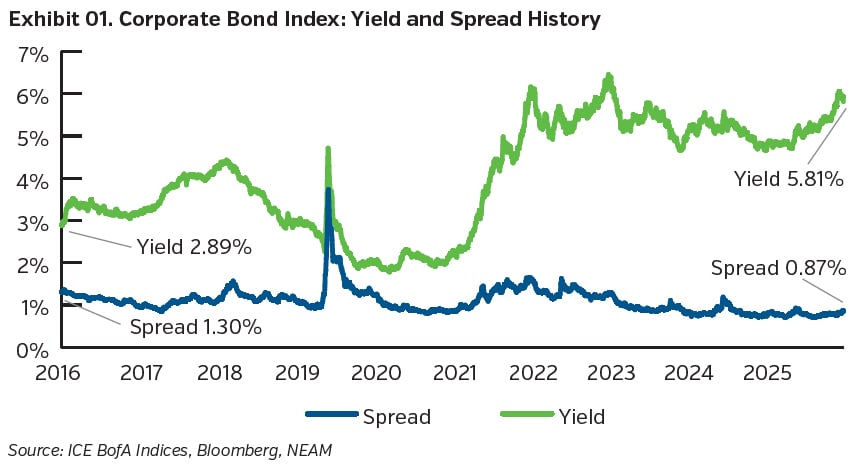
This combination of high absolute yields and low spreads creates a distinctly different investment challenge than prior periods. Historically, investors often relied on spread tightening or incremental risk to generate excess returns. Today, a significant portion of expected fixed income returns comes from underlying Treasury yields rather than spreads. As a result, portfolio success is likely to depend less on broad market beta and more on disciplined security selection, active yield curve management, and effective downside risk control.
The Opportunity: Attractive Absolute Yields
The most important feature of today's market is that investors can earn compelling yields without moving down the credit spectrum or extending duration. Investment-grade bond yields generally range between approximately 5% and 6%, levels that compare favorably with both recent history and broad institutional return requirements.
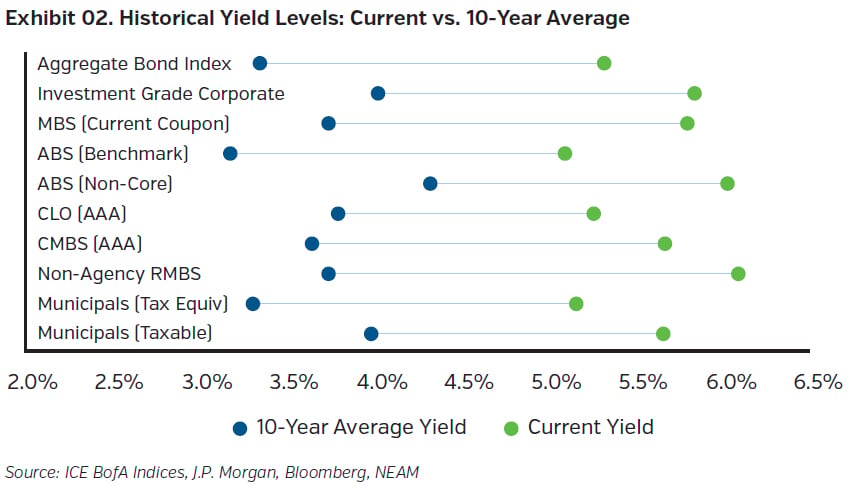
For insurance companies, this development is particularly significant. After years of operating in a near-zero interest rate environment, insurers can once again generate meaningful portfolio income from high-quality fixed income assets. The ability to earn attractive book yields from investment-grade securities improves earnings visibility, supports return-on-equity (ROE) targets, and reduces the pressure to pursue more aggressive asset allocation strategies.
The Challenge: Little Compensation for Incremental Risk
While absolute yields are attractive, spread compensation relative to the risk-free rate tells a different story. Spreads across investment-grade fixed income sectors remain below historical averages, reflecting strong demand from investors and a broadly constructive economic outlook.
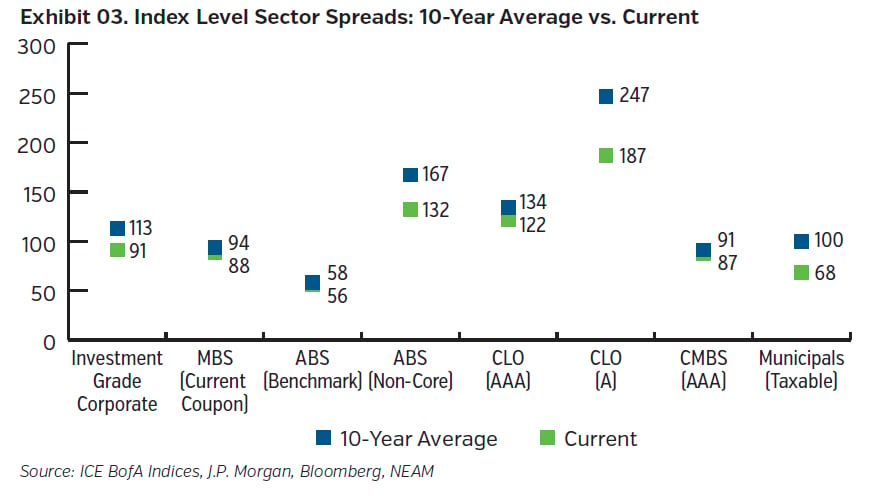
The implication is straightforward: investors are being paid more for interest-rate exposure rather than incremental risk. When valuations are rich (spreads are tight), the margin of safety against adverse credit developments is small. A downgrade, earnings disappointment, industry disruption, or weakening balance sheet can quickly overwhelm the limited added spread income earned from taking on more risk.
In this environment, reaching for yield by migrating into lower-quality issuers may only marginally increase return while materially increasing downside risk. The asymmetry is unfavorable: upside is capped by already-tight spreads, while downside remains substantial if credit fundamentals deteriorate. So, what is the appropriate strategy for an insurance company in this type of environment?
1. Focus on High Quality
The first principle of investing in a high-yield, low-spread environment is to maintain a bias toward quality. When spreads are wide, investors can often justify accepting additional risk because they are being generously compensated. Today, the opposite is true. The added spread between higher-quality and lower-quality credits is relatively modest compared with the potential cost of a downgrade or default.
For insurance investors, this means (i) emphasizing corporate issuers with strong balance sheets, stable cash flows, and resilient business models, (ii) focusing on structured securities with durable collateral pools and tranches with significant credit enhancement and (iii) finding highly rated issuers in overlooked sectors (like taxable municipal bonds) in order to lock in attractive yields while preserving portfolio stability.
2. Emphasize Security Selection
With broad market spreads compressed, alpha generation increasingly depends on issue selection rather than sector allocation alone.
Investors should focus on identifying issuers where credit fundamentals are improving, leverage is declining, free cash flow generation is strengthening, and management teams remain committed to bondholder-friendly capital allocation. Conversely, credits facing secular disruption, elevated refinancing needs, or aggressive shareholder distributions warrant caution.
The differentiating factor is no longer simply owning corporate credit; it is owning the right corporate credit. In a low-spread environment, avoiding poor issuers can be just as valuable as identifying outperformers.
3. Actively Manage the Yield Curve
A less predictable Federal Reserve creates opportunities across the Treasury curve.
As markets adjust to evolving inflation and growth expectations, shorter and intermediate maturity points, particularly the two to five year segment, can experience significant volatility. These movements create opportunities to tactically extend duration and lock in attractive yields when dislocations occur.
Rather than relying solely on spread income, investors can enhance returns through disciplined yield curve positioning and purchases during periods of curve volatility may allow portfolios to capture higher all-in yields without additional credit risk.
4. Prioritize Downside Risk Management
In today's market, avoiding losses is likely to be more important than maximizing yield.
When spreads are already tight, there is limited room for further gains from even lower spreads. Consequently, the potential reward from taking additional risk is constrained. The larger risk is adverse credit migration.
Rigorous surveillance of portfolio holdings, proactive management of downgrade risk, and disciplined exposure limits are therefore essential. Investors should focus on preserving capital by avoiding deteriorating credits before ratings agencies act.
The objective is simple: earn the attractive yields currently available while minimizing the probability of permanent capital impairment.
Key Takeaways
• The defining characteristic of today's fixed-income market is that investors can obtain historically attractive yields without taking extraordinary credit risk. However, because credit spreads remain compressed, investors are not being adequately compensated for indiscriminately moving down in quality.
• The optimal strategy is therefore not to reach for yield, but to harvest available yields through high-quality credit exposure, disciplined security selection, active yield curve management, and rigorous downside protection.
• For insurance companies in particular, this approach offers the opportunity to support ROE objectives while maintaining balance sheet resilience in an increasingly uncertain market environment.