



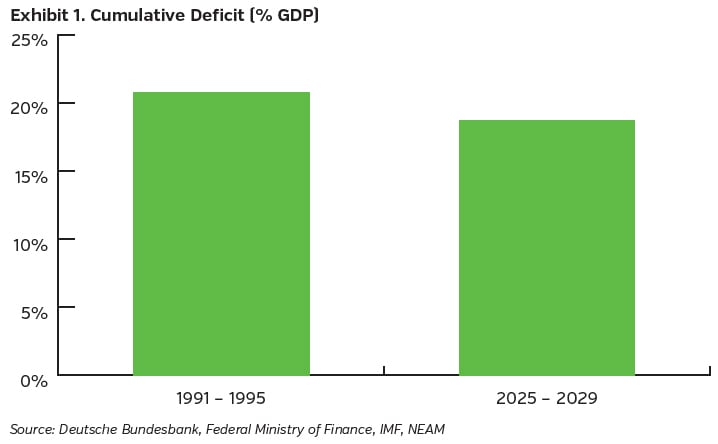
In the Spring of 2025 Germany announced its intention to increase spending in a manner that was unimaginable at the start of this year, not to speak of a decade ago. The scale of Germany’s fiscal shift is enormous with potential implications for economic growth, inflation, and geopolitics. Exhibit 1 illustrates that expenditure in the coming years (% of GDP) is forecast to rival the amount spent on German reunification.
It could be argued that it began in 2022 when then German Chancellor (Prime Minister) Olaf Scholz set up a €100 Billon Off Balance Sheet fund for defence. This was initiated by Chancellor Scholz in response to Russia’s invasion of Ukraine and the change that implied in Europe’s security/defence position. Germans remember the policy change as Zeitenwende or turning point in Germany’s response.
Following that initial salvo, the major change in approach came in 2025. Russia’s continuing war in Ukraine deepened concerns regarding European security. The change of administration in the US was also an important factor. President Trump has long been a critic of the low level of defence expenditure by European NATO members. The President’s perceived conditionality on continuing defence support for Europe through US involvement in NATO caused alarm in Berlin and other European capitals while the reception that Ukrainian President Zelensky received at the White House earlier this year shocked Europeans. US Vice President Vance’s speech at the Munich Security Conference early in the year added to a sense that the relationship between the US and Europe was altering in a fundamental way.
Germany’s economy had evolved in a manner that led to reliance on Russia for energy, the US for defence and China for trade. All three supports were increasingly being questioned, economic growth in Germany had flatlined and the decision to invest heavily in creating domestic autonomy from a security and economic growth perspective was decided upon. The lesson Europe (especially Germany) drew was the need for greater strategic autonomy.
Germany’s Fiscal Expansion Plan
German fiscal policy operates within a constitutional balanced budget requirement. The proposed fiscal expansion received parliamentary approval in September (separate from the annual budget process) and the three key elements of the plan are as follows.
1) €500 billion special purpose vehicle for infrastructure investment
2) Reform of the debt brake to exempt defence spending > 1% of GDP, permitting open ended defence borrowing
3) Reform of the debt brake at the Federal States level to raise their net borrowing cap to 0.35% of GDP from 0% currently.
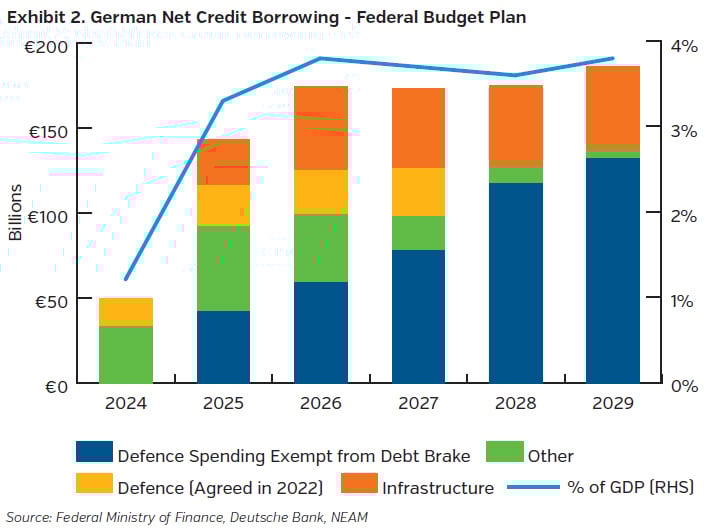
Exhibit 2 illustrates the scale and composition of borrowing to be undertaken as part of the plan. General government deficits are likely to be in the range of 3.5% to 4% on an annual basis to the end of the decade. Defence spending is scheduled to increase to 3.5% of GDP over the course of the plan, the agreed NATO long-term target, however Germany is planning to reach the target five years ahead of the 2035 schedule. The Federal Government is planning borrowing of €850 billion over the five-year period outlined in Exhibit 2.
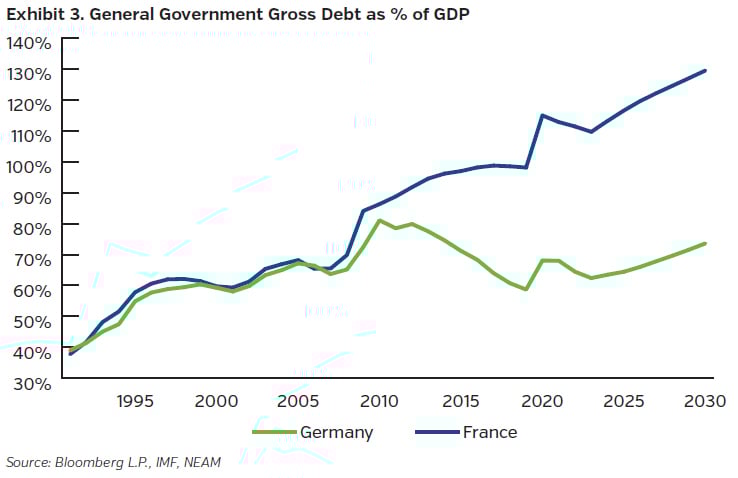
Few other EU/NATO nations could make such a large, sudden change in fiscal policy and finance it entirely by borrowing. Exhibit 3 outlines the enduring and cumulative impact of the constitutional balanced budget provision (the Debt Brake). At the introduction of the German Debt Brake in 2009, France and Germany had similar Debt/GDP ratios and the debt dynamics had evolved similarly for the previous twenty years. In the past fifteen years the relative fiscal position of the two countries has deviated substantially, and French government debt is almost twice the level of German government debt on a relative basis. The increase in fiscal spending planned for Germany in the coming years will probably add 10% to 13% to the German national debt ratio. The deficits that Germany plans for the next several years would normally risk breaking the EU’s fiscal rules regarding each member state’s debt and deficit ratios. However, there is a national escape clause in place exempting defence spending of up to 1.5% of GDP from the deficit calculation for four years as EU member states attempt to build their defence capacity. In addition, the EU has upgraded its long-term potential growth forecast rate for Germany based on the infrastructure spending plan - making that part of the fiscal plan more acceptable to EU fiscal rules.
Economic Implications
The fiscal boost has the potential to support the development of the German manufacturing sector as it transforms from one that has traditionally been energy intensive, to one that is more focused on technology and the digital economy. Fiscal spending on both infrastructure and defence holds out the possibility of supporting German manufacturing’s development in a manner suitable for a more modern economy.
Economic growth is forecasted to increase meaningfully in Germany in 2026, following a stall in recent years after the energy price shock from Russia’s invasion of Ukraine and recent trade war and geopolitical tensions. Contributing to growth forecast upgrades is a belief that defence spending will have more of a local component than previously anticipated. There is a greater than expected share of German and European orders to date as contractors add to capacity, partly by using spare production facilities previously used by the auto sector. New technologies, including robotics and communications are also being developed locally.
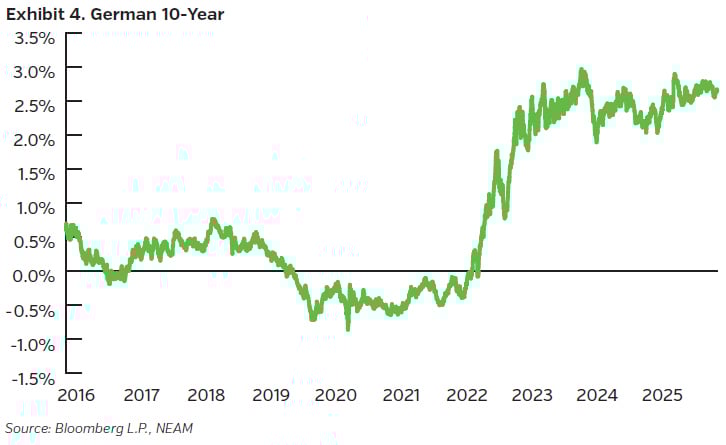
The German fiscal plan, based on a changing world order that requires greater strategic autonomy is likely to signal that EUR bond yields will not revert to the extremely low levels seen in the decade after the global financial crisis. ECB monetary policy was the sole source of support to the European economy a decade ago. It’s clear that a changed world will see more fiscal intervention and higher bond yields.
Key Takeaways
- Germany has executed a large and unexpected shift in fiscal policy that will last for five years.
- The catalyst was a changing world order that challenges Germany’s economic model.
- Germany possesses the fiscal strength to pursue the change of policy.
- Structural reform is also needed to create long-term economic growth benefits.
- Spillover to other European countries is anticipated to be positive.
- Greater fiscal spending makes it likely that the ECB rate cutting cycle is over.
- European bond yields are likely to remain at higher levels than seen in the decade after the GFC.